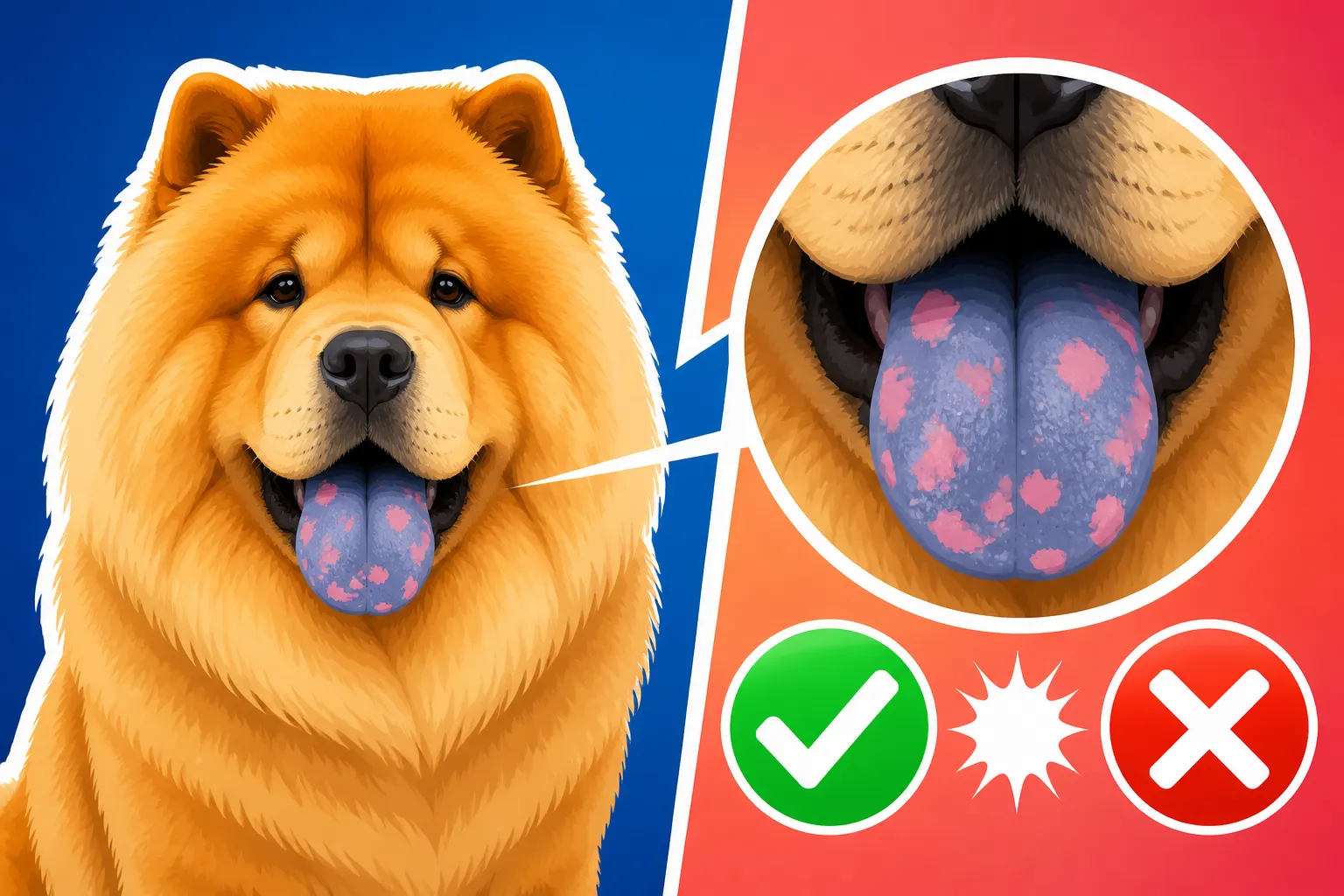
Whether a Pink Spotted Tongue Disqualifies a Chow Chow
A Chow Chow’s tongue is expected to be solid dark blue-black, so pink spots can worry owners who are checking the breed standard or wondering whether something is wrong. The answer depends on the dog’s age and what you mean by “disqualifies”: a pink-spotted tongue can be a show-ring disqualification, but it does not automatically mean a dog is unhealthy or not a Chow Chow.
What the Chow Chow tongue standard says
A Chow Chow’s tongue should become blue-black
The characteristic Chow Chow tongue is solid dark blue-black. The breed standard also describes dark pigmentation around the mouth, including the lips and roof of the mouth. That distinctive coloring is part of the breed’s appearance, but it is not a test that can prove a dog’s pedigree by itself.
If you’re comparing your dog with the standard, look at the tongue’s overall color rather than expecting every part of the mouth to match exactly. Pigmentation may be easier to see in some areas than others, and lighting can make a dark tongue appear lighter or uneven in a photo. The mouth should be checked gently, when your dog is relaxed, rather than held open by force.
The Chow Chow’s tongue is discussed in more detail in Why a Chow Chow's Tongue Is Not Pink. It’s also useful to understand that the dark color is not necessarily present at birth. Puppies often begin with pink tongues, and pigmentation develops as they grow.
What a pink spot means in the show ring
Under the AKC breed standard, a tongue that is red or pink, with or without one or more red or pink spots, is a disqualification in conformation competition. In plain terms, a Chow Chow with a permanent pink area on the tongue would not meet that part of the standard for the show ring.
That ruling is about judging a dog against a written breed standard. It is not a diagnosis, and it does not mean the dog is less lovable, less capable of being a companion, or automatically unhealthy. A Chow Chow can be a wonderful family dog without being eligible to compete in conformation shows.
It helps to separate three questions that often get tangled together:
| Question | What a pink spot may mean |
|---|---|
| Does it meet the conformation standard? | A permanent red or pink area can be disqualifying under the AKC standard. |
| Does it prove the dog is not a Chow Chow? | No. Tongue color alone cannot establish breed or pedigree. |
| Does it mean the dog is ill? | Not by itself. A new or changing area should be assessed in context. |
If you plan to show your Chow Chow, ask the event’s governing organization or a knowledgeable breed mentor how the standard applies to your dog. A photograph may not show the color accurately, and a judge evaluates the dog in person. For a broader explanation of how the blue-black color develops, see What Pigment Makes a Chow Chow's Tongue Blue.
Why a Chow Chow may have pink on its tongue
The dog may still be a puppy
A pink tongue is normal in a very young puppy. The dark pigmentation usually develops gradually, so a puppy’s tongue may look partly pink and partly blue-black while the color is coming in. The timing and pattern can vary from one puppy to another.
This is why age matters before drawing conclusions from a quick look. If a young puppy has some darkening but still shows pink areas, that alone does not tell you that the pigmentation is finished. The related guide When a Chow Chow Puppy's Tongue Turns Blue explains what owners may notice during this change, while The Age a Chow Chow's Tongue Finishes Darkening focuses on when the process is generally expected to be more complete.
A practical approach is to take clear, dated photos over time rather than repeatedly inspecting the mouth in a way that stresses the puppy. Use consistent lighting, and note whether the area is gradually darkening, staying the same, or changing suddenly. If you’re preparing for a show, speak with the breeder or an experienced Chow Chow exhibitor rather than relying on a puppy’s early tongue color as a final verdict.
Pigmentation can vary, and tongue color is not a pedigree test
A pink spot does not, by itself, prove that a dog is mixed or that a breeder misrepresented the dog. Breed identification involves more than one physical trait, and a dog’s papers and documented background are more relevant to pedigree than a single patch of pigment.
The same caution applies in reverse. A dark tongue does not prove that a dog is a purebred Chow Chow. Some other dogs can have dark pigmentation, and mixed-breed dogs may inherit traits from their ancestry. Whether a Blue Tongue Proves a Dog Is Part Chow Chow covers why tongue color should not be used as a stand-alone breed test.
For an owner who bought a puppy expecting to show, the most useful next step is a calm conversation with the breeder. Share clear photos, ask what the breeder observed in the litter, and review the registration and purchase documents. Avoid assuming bad intent based only on a young puppy’s developing color. If the dog is already an adult and the pigmentation is stable, the discussion is more about conformation eligibility than a sudden developmental change.
A new pink area is different from a lifelong spot
A spot that has been present for as long as you can remember is different from a patch that appears to have changed recently. A sudden color change, sore-looking area, swelling, bleeding, ulceration, bad breath, or reluctance to eat deserves attention from a veterinarian. Those signs do not point to one specific cause on their own, but they are reasons not to treat the issue as merely cosmetic.
Try to note when you first saw the change, whether it is on the tongue’s surface or edge, and whether your dog seems uncomfortable. Don’t scrape, scrub, or apply a home remedy to the area. A vet can examine the mouth and decide whether the change looks like ordinary pigmentation, irritation, injury, or something that needs further investigation.
If your Chow Chow is comfortable and the pink area is longstanding, it may simply be a pigmentation difference. If it is new or accompanied by other symptoms, the priority is your dog’s health—not whether the tongue meets a show standard.
How to check your Chow Chow’s tongue safely
Choose a calm moment and keep the check brief
Pick a time when your dog is settled, perhaps after a quiet walk or while resting at home. Let your Chow Chow approach you, and avoid leaning over the dog or gripping the muzzle tightly. Many dogs dislike having their mouths handled, and Chow Chows can be especially uncomfortable with unexpected restraint.
Start by touching the cheek or chin briefly, then reward your dog for staying relaxed. If the dog accepts it, lift the lip gently and look at the tongue when it naturally moves. You do not need to pull the tongue out or hold the mouth open for a long inspection. Stop if your dog stiffens, turns away repeatedly, growls, or tries to leave.
Small rewards can help build cooperation over time. Some owners keep dog-safe training treats on hand; Chewy is one place people may look for such supplies. The goal is not to bribe a dog into tolerating force, but to make brief, gentle handling predictable and positive.
Record what you see without overchecking
Take a clear photo if you need to compare the color later or share it with a veterinarian or breeder. Use good natural light, but don’t use a flash so close that it changes how the pigment appears. Include the date and a short note about whether the area is new, stable, or changing.
Checking repeatedly throughout the day is unlikely to give you better information and can make a dog increasingly resistant to mouth handling. A brief check during routine care is usually more useful. You can also get your dog accustomed to mouth checks alongside other cooperative-care habits, such as allowing the ears and paws to be examined.
If your Chow Chow resists, don’t turn a simple observation into a struggle. A veterinary team can examine the mouth safely, especially if the tongue looks painful or you’ve noticed other changes. For everyday dental care, a dog-specific toothbrush and toothpaste are the right kind of supplies; Chewy is one retailer where owners may find those items. Never use human toothpaste unless a veterinarian specifically advises it, since some ingredients can be unsafe for dogs.
Know when to ask a professional
A stable pink spot in an otherwise comfortable adult dog is usually a different situation from a newly changed, painful-looking patch. Ask a veterinarian about changes that develop quickly, bleeding, sores, swelling, difficulty eating, drooling beyond your dog’s normal pattern, or a noticeable change in behavior.
For show eligibility, ask a knowledgeable conformation judge, breed club contact, or experienced Chow Chow exhibitor. A veterinarian is the right person to assess health; a judge evaluates whether a dog conforms to the show standard. Those are related but separate roles.
If you are trying to understand the rest of the mouth’s pigmentation, Whether a Chow Chow's Gums Are Also Dark and Whether the Roof of a Chow Chow's Mouth Is Dark can help you know what owners commonly look for. These details may help you describe what you see, but they still do not replace an examination when there is a health concern.
What to do if your Chow Chow has a pink-spotted tongue
If your dog is a puppy
If your puppy is young and the tongue is partly pink, keep an eye on how the pigmentation develops without treating the color as a crisis. Ask the breeder what they have observed in the litter and whether the puppy’s tongue has been changing. If you have a show prospect, raise the question early so you have a realistic understanding of the standard and your options.
For routine home checks, reward calm cooperation and keep each look short. You can also use regular grooming or care routines to build comfort with gentle handling. If you’re shopping for dog-safe training rewards, Chewy may be one option, but the important part is choosing treats your puppy tolerates and using them to reward relaxed behavior.
If your dog is an adult and the spot has always been there
If the pink area is longstanding and your dog is eating and behaving normally, first decide whether your concern is about conformation showing, health, or breed identity. For a conformation question, the standard is clear: a permanent red or pink area can be disqualifying. For breed identity, tongue color alone is not enough to confirm or rule out ancestry. For health, a stable spot without other symptoms is not automatically a medical problem.
If the dog’s background matters to you, review registration records and talk to the breeder or rescue organization. If the concern is whether the mark has changed, compare a recent photo with an older one and contact your veterinarian if you notice a new lesion or other symptoms. A dog’s value as a companion does not depend on whether its tongue is perfectly uniform.
If the color changed recently
A recent change deserves a health-focused response rather than a show-focused one. Make an appointment with your veterinarian and share when you first noticed the change, any photos, and any related signs such as discomfort, reduced appetite, bleeding, or drooling. Don’t try to diagnose the cause from color alone.
Until your dog has been assessed, avoid poking at the spot or putting products on it. If your dog is struggling to eat, has significant bleeding, or seems acutely unwell, seek veterinary help promptly. A calm, gentle approach will make the examination easier and help your vet get a better look.
Ultimately, a pink-spotted tongue can disqualify a Chow Chow from conformation competition under the relevant breed standard, but it does not automatically disqualify the dog from being a Chow Chow, a healthy pet, or a beloved member of the family. Age, whether the spot is stable or newly changed, and the reason you’re asking all matter.
Disclaimer
This article is for general informational purposes only and does not constitute professional advice. Laws, prices and regulations vary by location and change over time. Consult a qualified professional for guidance on your specific situation.