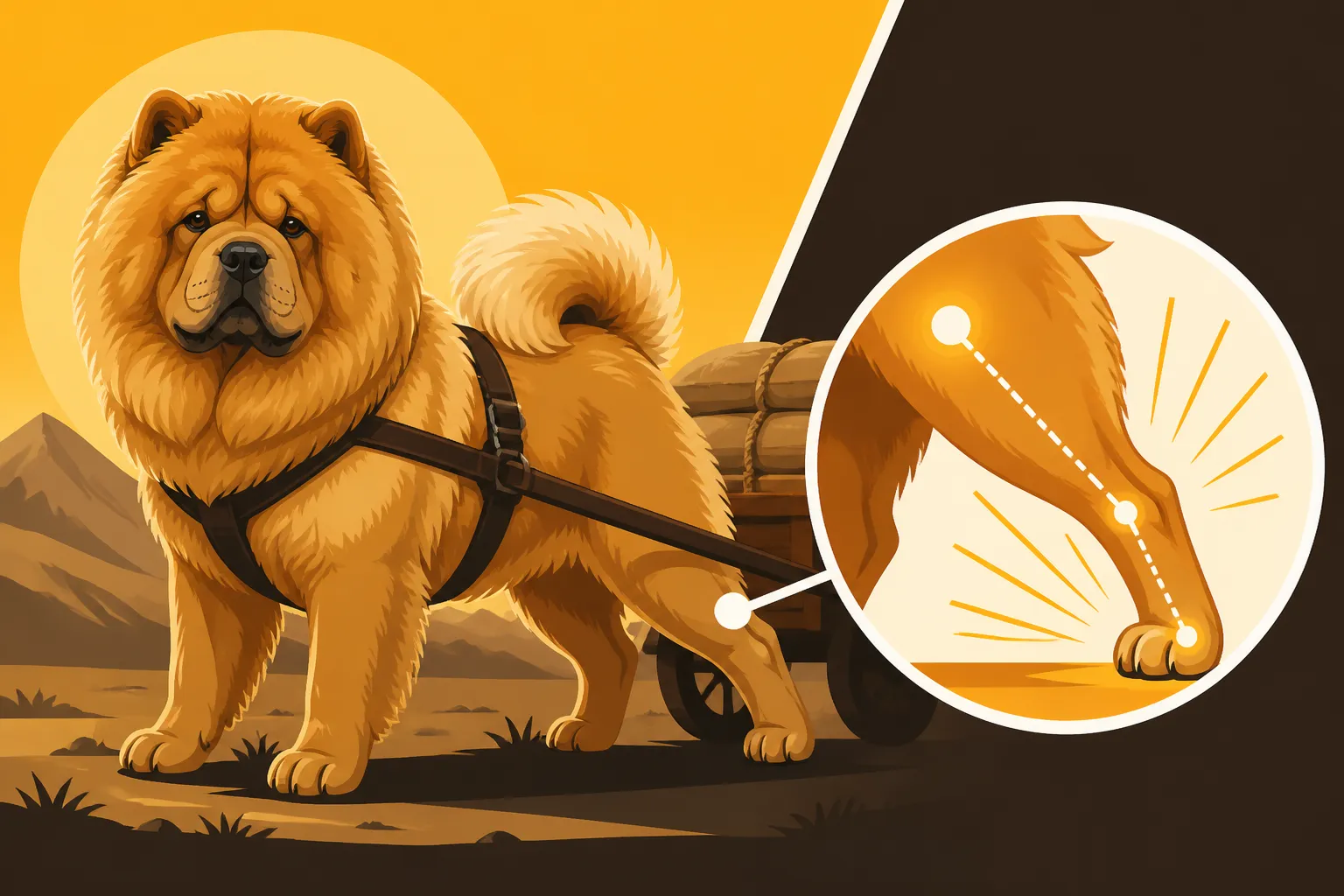
What the Straight Rear Leg Did for a Working Chow Chow
A Chow Chow’s nearly straight rear legs can make its walk look stiff beside the springier stride of many other dogs. That distinctive build is part of the breed’s working-dog story, but it does not mean every Chow moved the same way or that the anatomy made the breed faster. Here’s what the structure may have offered, what it means for movement, and what owners should watch today.
What people mean by a Chow Chow’s straight rear leg
A less angulated hindquarter
When people describe a Chow Chow as having a straight rear leg, they are usually talking about the shape and angles of the hindquarter, not a leg that is literally rigid. Compared with breeds whose rear legs show more pronounced bends, the Chow Chow has relatively little angulation. Its hocks—the joints above the back feet—tend to sit low and look straight, while the stifle, or knee, is less sharply bent than in many dogs bred for speed or jumping.
That structure contributes to a compact, sturdy outline. The breed’s hind legs appear to support the body directly, rather than forming the dramatic curves seen in a Greyhound or a dog built for powerful leaps. The Chow Chow’s characteristic way of moving, sometimes described as stilted, is closely associated with this anatomy. For more on that connection, see Why a Chow Chow Walks Stiffly.
“Straight” should not be confused with a medical diagnosis. A dog’s posture and gait depend on more than its breed outline: age, muscle condition, weight, joint health, and individual variation all matter. A Chow Chow who has always moved with a short, steady stride may simply be showing a typical breed characteristic. A dog who suddenly becomes stiff, limps, or struggles to rise needs a veterinary assessment rather than an assumption that its movement is normal for the breed.
Structure is not the same as a single proven purpose
It is tempting to ask what one body feature was “for,” as if breeders deliberately designed it to perform one specific task. The history of the Chow Chow is not that tidy. The breed has been associated with several kinds of work, including guarding, hunting, and pulling or carrying loads. Those activities call for different skills, and the dogs that performed them would not necessarily have had identical builds or movement.
A relatively straight hindquarter may have suited steady, practical movement better than the extreme propulsion needed for sprinting or repeated jumps. But that is a reasonable interpretation of the build, not proof that a particular historical job created the feature. Breed history includes long periods, different regions, and working roles that were not recorded in a modern performance-testing framework. The Chow Chow Is One of the Oldest Breeds in the World provides broader context for why the breed’s past cannot be reduced to one job or one moment of development.
The safest way to describe the leg is therefore in terms of what it does mechanically: it produces a particular outline and contributes to a distinctive gait. Claims that the structure made every Chow Chow stronger, more durable, or better at a specific task go beyond what the anatomy alone can show.
How the hindquarter may have helped a working Chow Chow
A steady, compact way of moving
A working dog did not always need to be the fastest animal in the field. Depending on the task, it might need to walk over varied ground, stay near people or livestock, patrol a site, or work for repeated stretches without explosive bursts of speed. A compact body and relatively upright rear assembly can be understood as part of a sturdy, ground-covering build rather than a design for racing.
That does not mean a straight rear leg automatically saves energy. Efficient movement depends on the whole dog: proportions, muscle, coordination, conditioning, and the surface underfoot. Nor does a breed’s appearance tell us exactly how an individual dog would have performed centuries ago. The useful distinction is that Chow Chows were not built like specialist sprinters. Their movement is generally more measured and less reachy than that of dogs selected for speed.
The breed’s outline also makes more sense when considered as a whole. Its broad head, substantial body, and short, sturdy frame combine with its hindquarter structure to create a distinctive silhouette. The Chow Chow's Straight Rear Leg No Other Breed Has discusses that feature as part of the breed’s defining form, rather than treating the rear legs as an isolated trick of design.
Working roles did not all demand the same movement
The phrase “working Chow Chow” can bring to mind one fixed image, but the breed’s historical associations span different activities. A dog guarding a home or cart would need to observe its surroundings and respond to a perceived threat; a dog used for hunting would face different physical demands; and pulling or carrying work would involve still another pattern of effort. The same basic body type could be useful in more than one setting without being optimized for every one.
This is one reason not to claim that straight hind legs were specifically developed for pulling, guarding, or hunting. A dog’s usefulness in those roles would involve temperament, training, stamina, and the conditions in which it worked—not just limb angles. Physical structure can shape how a dog moves, but it cannot tell the whole story of what the dog did.
If you want to explore the historical roles separately, What a Chow Chow Hunted in China and Whether Chow Chows Guarded Junks and Carts offer useful starting points. They help put the breed’s build into a broader working context without assuming that one physical trait explains its entire history.
What the characteristic gait looks like
Shorter, more upright steps
A Chow Chow may look as though it is taking shorter, more upright steps behind than a dog with more angulated hindquarters. Its rear legs do not necessarily swing forward with the same visible reach or spring. The resulting motion can look firm and somewhat restricted, especially when the dog is walking slowly across a smooth floor or moving on a short lead.
A breed-typical gait is not the same as discomfort. Some healthy Chow Chows move with an unmistakable, compact rhythm, and their individual stride can vary with speed, age, body condition, and excitement. It is more useful to watch whether the dog moves comfortably and consistently than to compare it with a different breed’s action.
A sudden change deserves attention. If a Chow begins taking shorter steps than usual, repeatedly shifts weight, favors one leg, or hesitates at stairs it previously managed, note when the change started and what seems to trigger it. A short video of the dog walking on a level surface can help a veterinarian understand what you are seeing, especially if the movement looks different at home than it does during an appointment.
Why a stiff-looking gait deserves context
The Chow Chow’s hindquarter structure is one reason the breed is often described as having a stilted gait. Still, “stilted” is a visual description, not a blanket explanation for every sign of stiffness. Pain, joint disease, injury, and changes in muscle strength can all alter a dog’s movement. The challenge for owners is that a dense coat and a naturally self-contained manner can make subtle changes harder to spot.
Notice the dog’s usual baseline: how easily it gets up after resting, whether it bears weight evenly, and whether it is willing to walk at its normal pace. Changes such as limping, reluctance to rise, a repeated “bunny hopping” motion, or difficulty settling comfortably should not be dismissed as part of the breed’s look. Elbow Dysplasia Ranks the Chow Chow Near the Top explains why joint health is an important part of the breed’s care, though a veterinarian must determine the cause of any particular dog’s symptoms.
For dogs who seem less confident on slick household floors, simple environmental changes may help reduce slipping while you arrange appropriate advice. Some owners look at traction mats or ramps through retailers such as Chewy, but a home aid is not a substitute for checking a new or worsening mobility problem with a veterinarian.
What this anatomy means for owners today
Support movement without forcing performance
A Chow Chow does not need to be trained like a sprinting or jumping specialist to stay active. Regular, comfortable walks and age-appropriate activity help maintain fitness, while repeated high-impact jumps or strenuous exercise beyond the dog’s conditioning may be a poor fit. The goal is not to keep the dog from moving; it is to build a routine that suits its individual comfort, health, and abilities.
Pay attention to the conditions as well as the distance. A dog that walks happily on a cool morning may struggle more in heat, and a route with uneven or slippery surfaces can reveal confidence or balance issues that are not obvious at home. If the dog is slowing down, offer breaks and choose a safer surface rather than trying to push through simply to complete a set distance. How Much Exercise a Chow Chow Actually Needs covers the broader question of activity in a way that accounts for the breed’s needs.
Keeping a Chow Chow at a healthy weight also matters for the workload placed on its joints. Because a thick coat can make body shape difficult to judge by sight, owners can ask a veterinary professional to demonstrate how to assess body condition by feel. For practical guidance on maintaining a suitable weight, see Keeping a Chow Chow at the Weight Its Elbows Can Carry.
Make the home easier to navigate
If a dog is slipping, start by identifying where it happens. A hallway with polished flooring, a smooth step near the door, or the route from a bed to a water bowl may be the trouble spot. Secure rugs or nonslip runners can give the dog a more confident path. A low ramp may help with a step or vehicle entry, provided the dog is comfortable using it and it is stable underfoot.
Introduce changes gradually. A ramp that appears helpful to a person may feel unfamiliar or wobbly to a dog, so let the Chow investigate it without pressure. Reward calm approaches and stop if the dog seems fearful. If you are comparing household aids, Chewy is one retailer owners may check for options such as nonslip mats or ramps; focus on the product’s stability and suitability for your dog rather than assuming any one aid will solve a mobility issue.
Keep a brief record if movement concerns recur: when they happen, how long they last, whether they affect one or both sides, and whether the dog seems uncomfortable after rest or exercise. That detail can make a veterinary conversation more useful. Chewy may also be a place to compare basic home-care supplies, but persistent stiffness, pain, weakness, or limping calls for veterinary evaluation, not just a different mat or ramp.
| What you notice | What it may mean | A sensible next step |
|---|---|---|
| A steady, compact gait the dog has always had | May reflect the Chow Chow’s characteristic movement | Monitor the dog’s usual comfort and stride |
| New stiffness after rest or exercise | Could have several causes, including joint or muscle problems | Track when it occurs and contact a veterinarian |
| Repeated limping or avoiding weight on a leg | Not something to explain away as breed type | Arrange veterinary assessment |
| Slipping on smooth floors | The surface may be difficult to grip | Try secure traction aids and watch for changes |
| Difficulty rising, climbing, or walking comfortably | May indicate pain, weakness, or another mobility concern | Seek veterinary guidance promptly |
The straight rear leg is best understood as one part of the Chow Chow’s distinctive build and measured way of moving. It may have suited steady, practical activity, but no single limb feature can prove exactly how an individual dog worked in the past. Today, the most useful distinction is between a familiar breed-typical gait and a new change in comfort or mobility.
Disclaimer
This article is for general informational purposes only and does not constitute professional advice. Laws, prices and regulations vary by location and change over time. Consult a qualified professional for guidance on your specific situation.