Why the Chow Chow’s Rear Leg Is Almost Straight
A Chow Chow’s rear legs can look unusually straight, and that stiff, almost stilted walk can make owners wonder whether something is wrong. In many cases, the shape is a defining feature of the breed rather than an injury. This guide explains what “straight” means, how it affects movement, and which changes deserve a veterinary check.
What “almost straight” means in a Chow Chow
The joints are there, but the angles are different
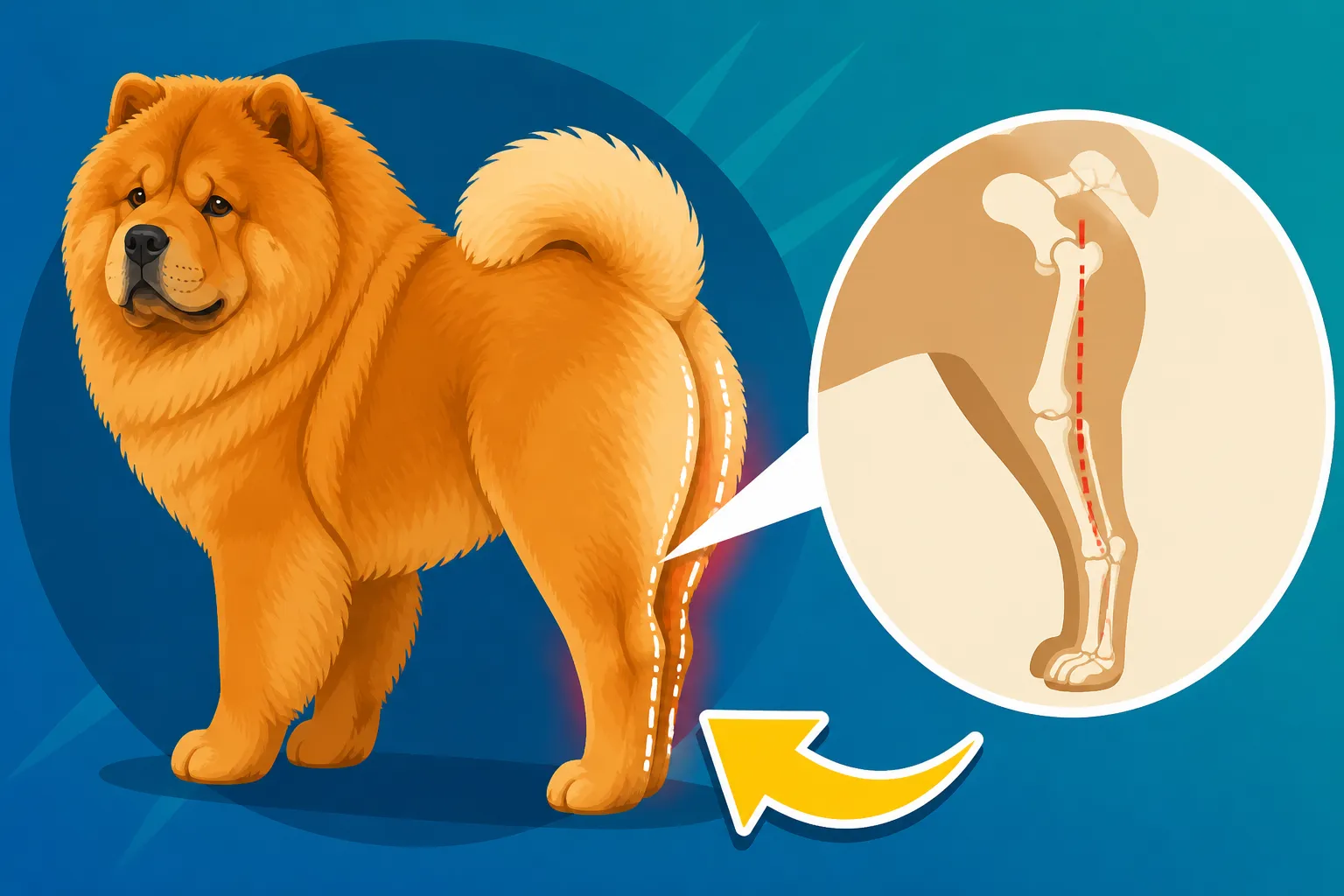
A Chow Chow’s rear leg is not a rigid column. It still has the same basic bones and joints as other dogs: the hip, knee, hock and toes all contribute to standing and movement. What looks different is the amount of bend, or angulation, through the hind limb. In a Chow Chow, the rear leg is relatively straight from the hip down toward the hock, with less of the pronounced bend people may expect to see in many other breeds.
The hock is the joint partway down the back of the lower leg, above the foot. In a typical Chow Chow stance, it sits fairly low, and the rear leg appears to descend with less obvious curve. Thick coat can make the outline harder to read, especially around the breeches and hocks, so what looks like a dramatic difference from the side may be partly obscured by fur.
“Straight” describes the leg’s overall shape and alignment, not an inability to bend. A Chow Chow still flexes its joints to walk, sit, rise and turn. The breed’s outline can simply make those movements look shorter and less fluid than the sweeping hind-leg action seen in more angulated dogs.
Why this feature is part of the breed
The straight rear leg is a recognized characteristic of the Chow Chow, not an accidental trait found only in a few dogs. It contributes to the breed’s distinctive outline and helps explain why its movement can look unlike that of a typical retriever or shepherd. The feature is often discussed alongside the breed’s compact body and unusual rear-leg structure.
Its history and function are explored in What the Straight Rear Leg Did for a Working Chow Chow. Whatever a dog’s individual background, though, the important point for an owner is practical: a characteristic appearance does not automatically mean a dog is uncomfortable, and it does not excuse a new limp or reluctance to move.
The phrase “straight rear leg” can also be misleading if taken too literally. It does not mean every Chow Chow should look perfectly straight in every position, or that a dog with more visible bend is necessarily unhealthy. Breed traits vary, and posture, coat, age and body condition all affect what you see. A veterinarian assesses the dog’s function and comfort—not just whether its silhouette matches a mental picture.
How it shapes the Chow Chow’s gait
Many Chow Chows move with a short, somewhat stiff-looking stride. Their hind legs may seem to travel with less extension behind the body than an owner expects, and the dog can appear to lift and place its legs in a compact, deliberate way. This is part of the reason people describe the breed’s movement as stilted; Why a Chow Chow's Gait Looks Stilted looks more closely at that impression.
A particular gait is not a diagnosis. If your Chow has always walked in a compact way, moves comfortably, and is willing to walk and play, that may simply be its normal movement. The useful comparison is often with the same dog over time: a sudden change in stride, pace or willingness to move matters more than whether the dog looks like another breed.
| What you notice | What it may mean | A sensible next step |
|---|---|---|
| Short, consistent steps with no signs of discomfort | May reflect the Chow Chow’s typical structure and movement | Observe the dog over time and mention it at routine checkups |
| New limp, uneven weight-bearing or a shortened stride on one side | May indicate pain or injury, among other possibilities | Arrange veterinary advice, especially if it persists or worsens |
| Stiffness after rest that eases or changes with movement | Can have several causes, including joint discomfort | Note when it happens and discuss it with a veterinarian |
| Reluctance to rise, jump or climb stairs | May signal discomfort or reduced mobility | Reduce strenuous activity and seek veterinary guidance |
| A puppy’s legs appear to change as it grows | Growth and posture can affect appearance | Ask the veterinarian to assess movement and development |
What straight hind legs mean for movement and joints
A breed feature is not the same as a joint problem
A straight-looking rear leg on its own does not prove that a Chow Chow has a joint disorder. Equally, a familiar breed outline should not be used to dismiss pain. A dog can have the characteristic structure and also develop an unrelated injury or an orthopedic condition. The way the dog moves, how its joints function, and whether it seems comfortable all matter.
The distinction is especially helpful when someone notices a stiff walk and immediately assumes the dog needs treatment—or, in the opposite direction, decides that every limp is “just how Chows walk.” Neither conclusion is safe without looking at the whole picture. Pay attention to changes such as favoring one leg, stopping during a walk, avoiding a previously easy movement, or taking longer to get up.
Joint conditions can affect dogs of many body shapes. Hip dysplasia, for example, involves the development and fit of the hip joint; it is not simply another name for a straight rear leg. You can read more in Hip Dysplasia in a Chow Chow. A veterinarian may assess the dog’s gait, examine its joints and recommend further tests if the findings call for them.
Comfort depends on more than leg shape
Movement is influenced by the entire dog: hips, knees, hocks, feet, muscles, body condition and the surface underfoot all play a part. A Chow Chow that is carrying extra weight may find movement harder, while a dog with weak traction on polished flooring may hesitate or splay its feet. Age, previous injuries and activity habits can also change how easily a dog gets around.
That is why it helps to look beyond a side-on photo. Watch your dog walking toward you, away from you and across a level surface. Notice whether the steps look even, whether the back end sways, and whether one paw lands differently. A short video taken at home can help you describe a concern to your veterinarian, especially if the movement changes from day to day.
A useful overview of how movement and joint wear relate is How a Chow Chow's Gait Wears Its Joints. It is not possible to tell from gait alone exactly what is happening inside a joint, but careful observation gives a veterinary professional better context than a general description such as “he walks funny.”
Other issues can resemble the breed’s normal movement
A luxating patella, or a kneecap that shifts out of its normal position, can cause intermittent skipping or an unusual step. That looks different from a dog that has always had a compact, even gait. Patellar Luxation in a Chow Chow explains the condition and the signs owners may notice.
Pain from a paw injury, a strained muscle, a sore hip or another problem can also change a dog’s stride. Dogs do not always yelp or make pain obvious. Some simply walk more slowly, avoid stairs, stop jumping into the car, or seem less interested in a familiar route. A normally reserved Chow Chow may show discomfort subtly, so changes in routine can be valuable clues.
If you are unsure whether a movement is normal for your dog, describe what you see rather than trying to name the cause. “She has started taking shorter steps with her right hind leg and hesitates before getting into the car” gives a veterinarian a clearer starting point than “her legs look wrong.”
How to support a Chow Chow’s mobility at home
Keep exercise regular and appropriate
Consistent, moderate activity helps maintain strength and routine without turning every walk into a test of endurance. Let your dog’s comfort guide the pace. For a Chow Chow that is used to leisurely neighborhood walks, a sudden jump to long hikes, steep hills or repeated high-impact play may be harder on the body than gradually increasing activity.
Puppies need particular care because their bodies are still developing. Avoid treating a young dog like a fully grown hiking companion just because it seems energetic in the moment. Ask your veterinarian about suitable activity for your puppy’s age and condition. When a Chow Chow's Growth Plates Close provides additional context about growth, but an individual puppy’s plan should still be discussed with a veterinary professional.
In warm weather, choose cooler parts of the day and take breaks. Chow Chows have a dense coat and can be vulnerable to overheating, so a walk that is reasonable in cool weather may become unsafe on a hot afternoon. If your dog slows down, seeks shade, pants heavily or seems weak, stop the activity and respond promptly.
Make floors and everyday routes easier to manage
Slippery floors can make a dog with compact movement less confident, particularly when turning, rising or crossing a smooth hallway. Place secure, nonslip runners along routes your dog uses often. Make sure they lie flat so they do not bunch up or become a tripping hazard. If your dog avoids one staircase or struggles to step into a vehicle, consider whether a ramp or a different route would reduce strain.
Chewy is one place owners may browse for nonslip runners, pet stairs or ramps, but check the dimensions and stability before choosing anything. A ramp should not wobble, slide or force the dog into a steep climb. For stairs, a product that shifts underfoot may make matters worse rather than better.
You can also make rest areas easier to reach. Put a comfortable bed on the level where your dog spends most of its time, and avoid asking an older or uncomfortable dog to repeatedly jump onto furniture. A ramp purchased through Chewy or another retailer is only useful if your dog can approach it calmly and use it with secure footing; introduce it gradually rather than pushing the dog onto it.
Maintain a healthy body condition
A thick coat can make it difficult to judge a Chow Chow’s outline by sight. Use your hands as well as your eyes: you should be able to feel the ribs beneath the coat without pressing hard, while they should not be sharply visible. Ask a veterinarian to assess body condition and suggest a feeding plan if you are uncertain.
If you are comparing food or feeding accessories through Chewy, treat product listings as a starting point, not a substitute for advice tailored to your dog. Food needs vary with age, activity, health and body condition. Avoid adding supplements or changing the diet to “fix” a gait without first asking a veterinarian; a supplement is not a diagnosis or a reliable replacement for an examination.
Weight management is not about making a Chow Chow thin. It is about helping the dog carry a healthy amount of weight so everyday movement is comfortable. If the coat hides gradual weight gain, occasional hands-on checks and routine veterinary visits are more useful than relying on a quick glance.
When to ask a veterinarian about a Chow Chow’s rear legs
Signs that deserve attention
A long-standing, even, compact gait in a comfortable dog is different from a new or worsening change. Contact a veterinarian if your Chow Chow begins limping, repeatedly skips a step, seems reluctant to rise, or avoids activities it previously handled easily. A change that comes on suddenly after a slip, fall or rough play should be taken seriously.
Also pay attention to less dramatic changes: slower walks, more frequent pauses, difficulty turning, hesitation on stairs, or a new preference for lying down. A Chow Chow may not make a fuss when sore, and a dense coat can hide changes in posture or muscle shape. The earlier you share a clear description, the easier it is to decide whether an examination is needed and how quickly.
If your puppy seems painful, has an obvious limp, or is struggling to stand or walk, do not wait for its legs to “grow out of it.” Signs a Chow Chow Puppy's Elbows Hurt discusses signs that can be easy to overlook. A veterinarian can determine whether the concern involves the elbow or another part of the body.
What an appointment may involve
The veterinarian may ask when you first noticed the change, whether it happens all the time, and what activities seem to bring it on. You may be asked to walk your dog on a flat surface so the clinician can assess the stride and symmetry. A physical examination can help identify areas of tenderness or limited movement. Depending on the findings, the veterinarian may discuss imaging or other tests.
Before the visit, write down a few observations: which leg seems affected, whether the problem is worse after rest or exercise, and whether your dog still climbs stairs or jumps into the car. A short video can be useful if the gait looks different at home than it does in the clinic. Do not deliberately make your dog repeat a movement that appears painful just to record it.
A diagnosis cannot be made from the breed’s outline alone. The straight rear leg is a characteristic feature, but a veterinarian needs to consider your dog’s age, history, examination and symptoms together. For a broader look at whether the feature itself is a problem, see Whether a Chow Chow's Straight Rear Leg Causes Problems.
Keep a simple record over time
If your Chow Chow has a known mobility issue or you are monitoring a subtle change, note what the dog can comfortably do each week. You might record walk length, ease of rising, stair use and whether the gait changes after activity. This does not replace a veterinary assessment, but it can make gradual changes easier to spot.
Keep the notes factual. “Needed a pause halfway through the usual route” is more useful than “seems old today.” If the dog has a sudden, severe change, cannot bear weight, or appears acutely distressed, contact a veterinarian promptly rather than waiting to collect more observations.
The goal is not to make every Chow Chow move like a different breed. It is to understand your own dog’s normal pattern, support comfortable movement, and notice when that pattern changes. A straight-looking rear leg can be part of the breed’s design; pain, limping and declining mobility deserve attention on their own terms.
Disclaimer
This article is for general informational purposes only and does not constitute professional advice. Laws, prices and regulations vary by location and change over time. Consult a qualified professional for guidance on your specific situation.