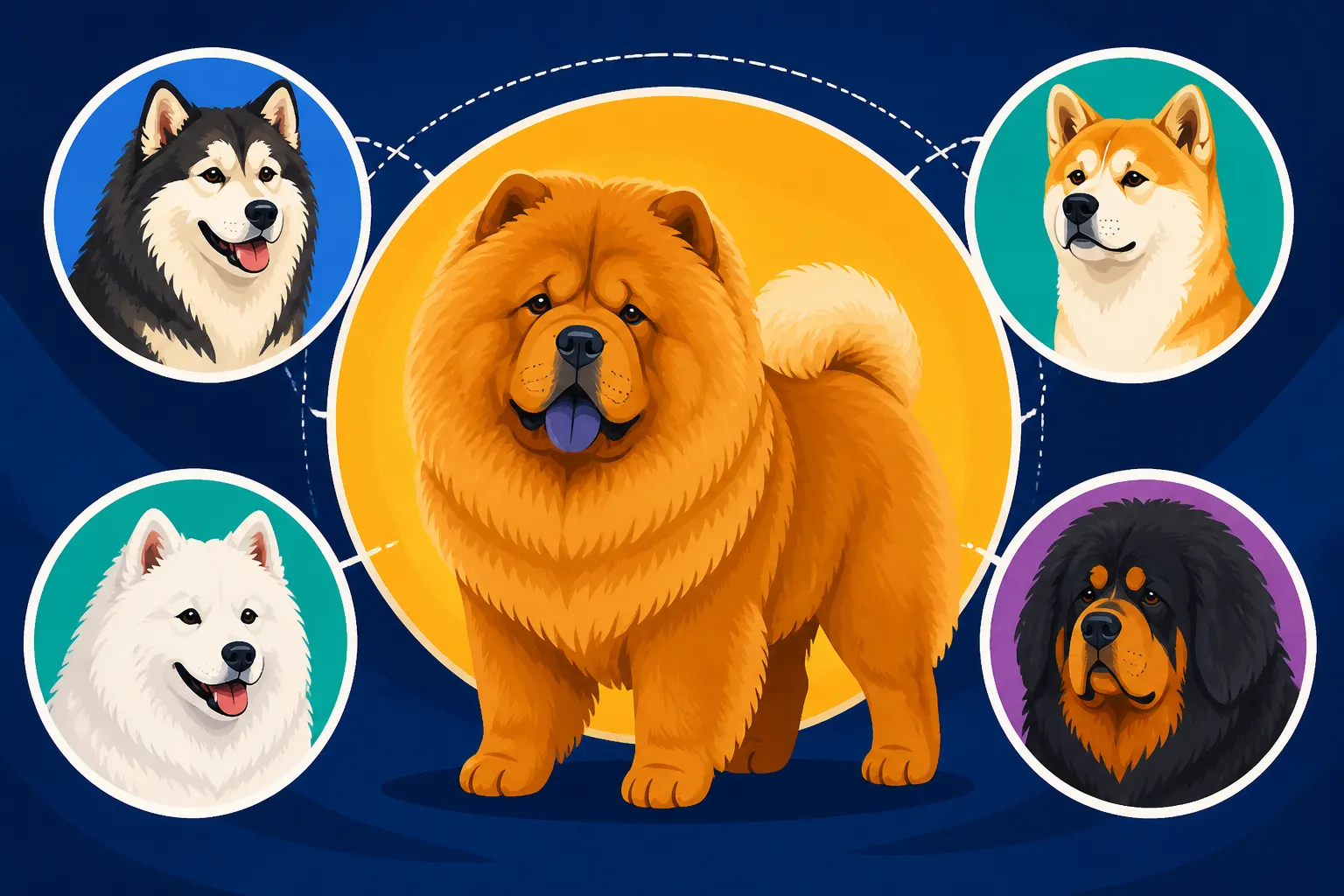
Which Breeds the Chow Chow Is Most Related To
It's completely natural to look at a Chow Chow and wonder about their family tree, especially with their distinctive look and personality. Many people struggle to understand where this ancient breed fits into the canine world, often seeing resemblances to other dogs but not quite knowing the full story. This guide will take a deep dive into the Chow Chow's lineage, exploring its closest genetic relatives and the breeds that often share common traits or are frequently mistaken for this magnificent dog.
The Chow Chow's Ancient Lineage and Genetic Neighbors
When we talk about the Chow Chow's relatives, we're not just talking about breeds that look similar, but those that share deep genetic roots. The Chow Chow is one of the most ancient dog breeds on the planet, tracing its origins back thousands of years to ancient China. This incredible history means that its family tree looks a bit different from many modern breeds.
Direct Descendants of Ancient Canids
The Chow Chow is often cited as one of the basal breeds, meaning it's one of the oldest and genetically closest to wolves, predating most modern dog breeds. Think about that for a moment – your Chow Chow carries a genetic blueprint that has remained relatively unchanged for millennia! This ancient heritage sets them apart, placing them in a small, elite group of dogs whose DNA gives us a window into early canine domestication. This is why when you look at certain traits, like their independence and sometimes aloof nature, it's a whisper from their distant past. They weren't bred for constant human companionship in the same way a Labrador might have been; their roles were often more solitary and protective.
This ancient connection means that while they aren't "related" to wolves in the modern sense of direct offspring, their genetic divergence from wolves happened much earlier than most other breeds. It’s like they were on one of the first branches to split off the main tree. This deeply rooted history is a significant part of The Chow Chow Is One of the Oldest Breeds in the World.
Other Ancient Asian Breeds
Given their origins, it's no surprise that some of the Chow Chow's closest relatives are also ancient breeds from Asia. These dogs likely developed in similar geographic regions or migrated alongside human populations across ancient trade routes, sharing a common genetic heritage.
One of the most commonly cited genetic relatives is the Shar Pei. While they look distinctly different with their wrinkled skin, the Shar Pei also hails from China and shares many genetic markers with the Chow Chow. Both breeds exhibit a certain independence and a strong protective instinct, traits that would have been highly valued in their original roles. Their shared ancestry is a fascinating peek into the evolution of working dogs in ancient East Asia. When you consider How a Chow Chow Differs From a Shar Pei, you start to appreciate both their distinct features and underlying connections.
Another breed often discussed in terms of ancient Asian lineage, though perhaps less directly related than the Shar Pei, is the Akita. Akitas originated in Japan and share a powerful, dignified presence, as well as a certain reserved temperament with strangers. While their specific developmental paths diverged, the shared "spitz-type" characteristics – dense double coats, curled tails, and prick ears – are often seen across many ancient Northern Asian breeds, hinting at a common distant ancestor or at least parallel evolutionary pressures in similar environments. To explore the differences in more detail, you might look into How a Chow Chow Differs From an Akita.
Breeds Often Compared to the Chow Chow
Beyond direct genetic ties, there are several breeds that people frequently compare to the Chow Chow due to shared physical traits, temperament, or even just a general "look." These comparisons are usually based on superficial resemblances rather than deep genetic relationships, but they are common points of discussion for curious owners and enthusiasts.
The Distinctive Blue-Black Tongue Club
Perhaps the most iconic physical trait of the Chow Chow is its blue-black tongue. This unique feature often leads people to wonder if any other breeds share this characteristic. Indeed, there are a few! The most prominent, and one we've already touched upon, is the Shar Pei. Both breeds are known for this distinctive pigmentation, which further solidifies their ancient Chinese connection. It's a hallmark that immediately sets them apart from most other canines. Why a Chow Chow's Tongue Is Blue Black delves into this fascinating trait in more detail.
However, it's worth noting that while rare, some other breeds can occasionally have spotted tongues, or even mostly blue tongues, though it's not a standard breed characteristic. This phenomenon is often attributed to pigmentation rather than a direct genetic relationship with Chows or Shar Peis. So, while a blue tongue might make you think of a Chow, it's not a definitive sign of direct kinship unless it's a Shar Pei. You can learn more about Which Other Breed Has a Blue Tongue.
Spitz-Type Breeds with Dense Coats
The Chow Chow falls firmly into the "Spitz" family of dogs, a group characterized by their northern origins, dense double coats, pricked ears, and often curled tails. This broad category includes a multitude of breeds, and many share a visual similarity with the Chow Chow, particularly due to their fluffy appearance.
For instance, the Keeshond, a delightful Dutch breed, often gets compared to the Chow Chow because of its luxurious, dense coat and expressive face. While Keeshonds are known for being much more outgoing and vocal than Chows, their fluffy ruff and curled tail certainly evoke a similar aesthetic. They share the general Spitz morphology but not necessarily a close genetic bond. Similarly, the Samoyed, with its beautiful white coat and "smiling" expression, is another Spitz breed that sometimes gets grouped mentally with the Chow Chow because of its profound fluffiness, though their temperaments are worlds apart.
The Eurasier is another interesting comparison. This breed was actually developed in Germany in the 1960s by crossing Chow Chows, Wolfspitz (which are closely related to Keeshonds), and later Samoyeds. So, the Eurasier literally has Chow Chow ancestry, making it a "related" breed in a very direct sense, sharing both genetic material and visual characteristics like a dense coat and sturdy build, albeit with a typically more open and friendly disposition.
Here's a quick comparison of some breeds often mentioned alongside the Chow Chow:
| Breed | Origin | Key Trait Similarity | Key Trait Difference | Relationship to Chow Chow |
|---|---|---|---|---|
| Shar Pei | China | Blue-black tongue, ancient lineage | Wrinkled skin, different coat texture | Close genetic relative |
| Akita | Japan | Spitz type, reserved demeanor | Larger size, different head shape | Distant ancient Asian relative |
| Keeshond | Netherlands | Dense coat, Spitz appearance | Highly social, vocal, different temperament | Shares Spitz classification, not direct relative |
| Eurasier | Germany | Dense coat, sturdy build | Bred from Chow Chow, more adaptable temperament | Direct descendant, modern breed |
| Samoyed | Russia | Dense white coat, Spitz appearance | Very social, smiling expression | Shares Spitz classification, not direct relative |
The Impact of DNA Research on Understanding Chow Chow Relations
Modern advancements in canine DNA research have been incredibly illuminating, helping us to trace the lineage of breeds with far greater accuracy than ever before. For ancient breeds like the Chow Chow, these studies reinforce what historical records and observations suggested, while also revealing some surprises.
Confirming Ancient Roots
DNA analysis consistently places the Chow Chow among the most ancient dog breeds, a "basal" breed whose genetic makeup has remained remarkably distinct from many of the more recently developed European breeds. This scientific confirmation underscores What DNA Says About the Chow Chow's Age and its profound connection to the earliest domesticated dogs. It's a powerful reminder that when you welcome a Chow Chow into your home, you're becoming part of a history that spans millennia.
These studies often group Chow Chows with other ancient Asian breeds, providing empirical evidence for the genetic relationships previously inferred from geographic origin and shared physical traits. It's like finding a precise map for an ancient family tree. This doesn't mean they are identical to their ancient ancestors, but their genetic blueprint shows less mixing and modification than breeds developed in more recent centuries.
Dispelling Myths and Clarifying Connections
While DNA confirms some relationships, it also helps clarify others. For example, some might assume a Chow Chow is closely related to a Tibetan Mastiff due to their lion-like appearance and Asian origins. While both are impressive, powerful breeds from Asia, DNA might show their paths diverged quite a long time ago, with different evolutionary pressures shaping their distinct characteristics. The Chow Chow's unique characteristics, like The Straight Rear Leg No Other Breed Has, are specific evolutionary traits that help distinguish it even from other ancient types.
The ongoing research continues to refine our understanding of canine evolution, offering a clearer picture of how breeds like the Chow Chow fit into the grand tapestry of dog history. It allows us to appreciate not only their unique traits but also their place as living relics of canine history, carrying genes that tell stories of ancient human migration and domestication. These insights can also influence our understanding of breed-specific health concerns and temperamental predispositions, though these are complex traits. When you're looking for quality food or supplements for your Chow Chow, remember that understanding their ancient dietary needs can be helpful, and resources like Chewy can offer a wide range of options to support their well-being.
What This Means for Chow Chow Owners
Understanding the Chow Chow's family tree isn't just a matter of historical curiosity; it provides valuable context for appreciating your own dog's unique traits and behaviors. Knowing that they come from such an ancient and distinct lineage can help you better understand their personality, which is often described as independent, reserved, and sometimes aloof. This isn't a flaw; it's a feature of their ancient heritage.
Appreciating Unique Temperamental Traits
The Chow Chow's tendency to bond deeply with one person, for example, is often seen as a reflection of their history as guardian dogs rather than pack hunters or constant companions. They were bred to be watchful and protective, often needing to make their own decisions in guarding their territory or family. This can be a stark contrast to many modern breeds developed for close human collaboration, like retrievers. Learning about The Chow Chow Bonds to One Person and Tolerates the Rest can really help you set realistic expectations for your relationship with your Chow.
Their reserved nature with strangers and their strong protective instincts are also hallmarks of their ancient roles. This isn't a sign of aggression in a well-socialized Chow Chow, but rather a natural caution and discernment. Early and consistent socialization is paramount for these breeds to ensure they grow into well-adjusted adults who can comfortably navigate the modern world. This deep dive into their ancestry helps us understand why they are the way they are, rather than simply labeling them as "difficult" or "stubborn."
Health Considerations and Breed-Specific Needs
While genetic relatedness helps us understand history, it can also highlight shared predispositions to certain health conditions among closely related breeds. For instance, eye issues like entropion or glaucoma, sometimes seen in Chows and Shar Peis, might stem from shared genetic factors related to their facial structure or ancient lineage. It's always crucial to research What a Chow Chow Breeder Should Have Tested and discuss potential breed-specific health concerns with your veterinarian.
Similarly, understanding their dense double coat, a characteristic shared with many Spitz breeds, immediately tells you about their grooming needs. Whether you have a rough-coated or smooth-coated Chow Chow, that dense undercoat requires diligent care. This is a characteristic shared with many of its "cousins" in the Spitz world. Proper grooming not only keeps them looking magnificent but also contributes significantly to their comfort and skin health, especially during seasonal coat blows. Products and tools designed for dense double coats are a must, and many owners find a wide selection available on sites like Chewy.
Ultimately, the Chow Chow is a fascinating breed with a rich, deep history reflected in its genes, appearance, and personality. By exploring its relationships to other breeds, we gain a more profound appreciation for this truly unique companion. Where the Chow Chow Comes From is a story that continues to unfold, revealing more about canine history with every new discovery.
Disclaimer
This article is for general informational purposes only and does not constitute professional advice. Laws, prices and regulations vary by location and change over time. Consult a qualified professional for guidance on your specific situation.