How to Tell a Chow Chow Mix From a Purebred
A dog can look unmistakably Chow-like and still have mixed ancestry, while a purebred Chow Chow may not match every familiar feature perfectly. Coat, blue-black tongue, and curled tail are useful clues, but none proves pedigree on its own. This guide explains what to look for, what records and DNA tests can tell you, and how to make a careful, fair assessment.
What Chow Chow features can and cannot tell you
Look at the whole dog, not one signature trait
Chow Chows have a distinctive overall appearance: a broad skull, small upright ears, deep-set eyes, a compact build, and a tail that curls over the back. Many have a dense coat and a characteristic, somewhat scowling expression. A dog that combines several of these features may resemble the breed strongly, but resemblance is not proof of purebred ancestry.
A single feature is especially easy to overinterpret. A curled tail, for example, occurs in other breeds and mixes. Likewise, a thick coat or broad head can come from more than one ancestral line. The more characteristics a dog shares with the breed, the more Chow-like it may appear—but visual clues can only support an educated guess.
Look at proportions and structure as well as color and coat. Chow Chows are known for a distinctive, relatively straight rear-leg structure and a firm, somewhat stilted gait. Still, a dog’s age, body condition, injury, and individual variation all affect how it moves. For more background, see Why a Chow Chow Walks Stiffly.
Treat the blue-black tongue as a clue, not a test
The blue-black tongue is one of the breed’s best-known traits, so it’s understandable to see it as a shortcut to identification. But tongue color alone cannot establish that a dog is a purebred Chow Chow. Some mixed-breed dogs inherit dark tongue pigmentation, while a dog’s mouth may show a mix of darker and lighter areas. Puppies’ pigmentation can also develop as they grow. Learn more in Why a Chow Chow's Tongue Is Not Pink and When a Chow Chow Puppy's Tongue Turns Blue.
A fully or mostly dark tongue can make Chow ancestry seem more plausible when other Chow-like features are present. It still doesn’t reveal whether the dog has one Chow parent, several generations of Chow ancestry, or a documented purebred pedigree. A visual sign can suggest a possibility; it cannot confirm a family tree.
Be cautious of claims that a tongue spot definitively proves a dog is part Chow. Pigmentation is not a reliable stand-alone ancestry test. Whether a Blue Tongue Proves a Dog Is Part Chow Chow looks at why this popular assumption can be misleading.
Understand how coat and color can vary
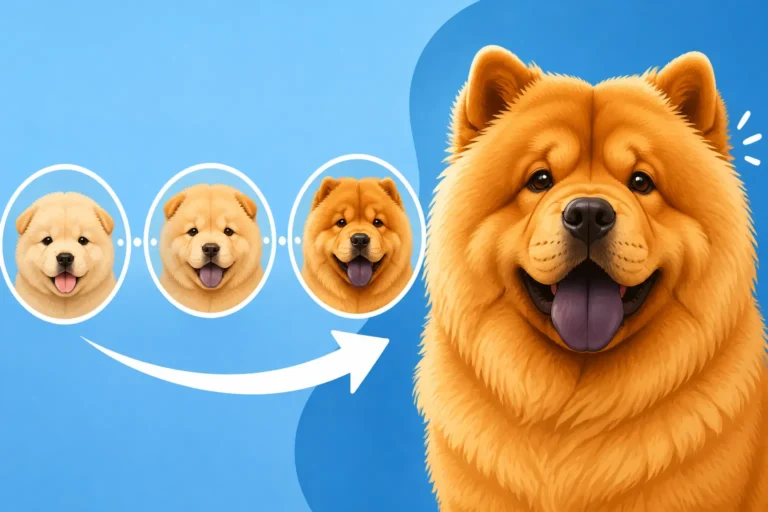
Chow Chows come in rough-coated and smooth-coated varieties, and both can be purebred. A smooth coat is not evidence of mixed ancestry. Coat length, fullness, and texture may also change as a puppy matures, and grooming can make a dog’s outline look quite different. A young dog’s coat may not yet show the adult ruff or body shape people associate with the breed.
The recognized Chow Chow color range includes red, black, blue, cinnamon, and cream. But a color that appears unusual does not automatically indicate a mix, and a familiar color does not prove purebred status. Lighting, coat condition, and age can affect how a color looks. For a closer look at the accepted range, see Which Colors a Chow Chow Comes In.
If you’re assessing a puppy, allow for change. Coat, head shape, body proportions, and pigmentation can develop over time. Comparing a young dog with a mature breed standard photograph can be misleading, especially when the puppy is still growing or has recently been clipped.
| Feature | What it may suggest | What it cannot prove |
|---|---|---|
| Blue-black tongue | Chow-like pigmentation | Purebred status or exact ancestry |
| Curled tail | A trait seen in Chow Chows and other dogs | That the dog has a Chow parent |
| Dense coat or neck ruff | A Chow-like coat pattern | Purebred ancestry |
| Broad head and upright ears | Similarity to the breed’s appearance | A documented pedigree |
| Chow-like gait | Similarity in structure or movement | Breed ancestry by itself |
| Registration or pedigree records | Documented lineage, if legitimate and verifiable | That the dog has no health or temperament concerns |
How to check lineage more reliably
Ask for pedigree and registration records
When a dog is described as purebred, the strongest evidence is a verifiable pedigree showing its ancestry. Ask the breeder or previous owner for the dog’s registration documents and information about its parents. Check that the names and identifying details match the dog, and ask which registry issued the paperwork. Registration paperwork documents a reported lineage; it is not the same thing as a physical examination or a guarantee that the dog will match every feature people expect.
If you’re speaking with a breeder, ask to see the mother and, when possible, learn about the father. Request the parents’ registered names and ask how you can verify their records. A responsible breeder should be able to discuss lineage clearly rather than relying on statements like “the puppy looks purebred” or “the parents were definitely Chows.”
Records matter beyond appearance. Health testing and thoughtful breeding practices are important whether you’re buying a puppy or researching a dog you already own. The questions in What a Chow Chow Breeder Should Have Tested can help you distinguish meaningful documentation from a sales claim.
Consider what a DNA test can and cannot do
A canine DNA ancestry test may estimate which breeds appear in a dog’s genetic background. This can be useful when a dog’s history is unknown, or when its appearance gives mixed signals. Results are best understood as estimates based on the test provider’s reference data, not as a replacement for a documented pedigree.
A DNA result can also be hard to interpret. A dog with a strong Chow-like appearance may receive a result showing several breeds, especially if the ancestry is mixed across generations. Conversely, a reported Chow percentage does not establish that the dog is registered as purebred or descended from a particular documented line. Different tests may use different comparison populations and methods, so their estimates can vary.
If pedigree status matters—for example, because you’re considering showing or breeding the dog—ask the relevant registry what documentation it accepts. A consumer ancestry test may be interesting, but it does not necessarily meet a registry’s requirements. If the dog’s identity or parentage is in question, ask a veterinarian or the registry about appropriate parentage testing rather than assuming a general breed-ancestry kit will settle it.
Keep visual identification in perspective
Breed identification from photographs is particularly uncertain. A camera angle can make the head look wider, a thick coat can hide the body outline, and a curled tail may be difficult to assess. Even people familiar with Chow Chows can disagree when they are looking at a puppy, a rescue dog with an unknown past, or a dog whose coat has been trimmed.
In-person assessment helps, but it still cannot establish lineage. A veterinarian can assess general health and physical features, and a knowledgeable breed expert may be able to comment on how closely the dog resembles the breed. Neither visual opinion should be presented as proof of pedigree unless it is supported by appropriate records.
It’s also worth separating the question “Does this dog look like a Chow Chow?” from “Is this dog a purebred Chow Chow?” The first can be answered as an observation. The second is a question about ancestry and documentation.
What mixed ancestry may look like
A mix may inherit some traits and not others
A Chow Chow mix can inherit the breed’s dense coat, broad face, dark tongue pigmentation, or curled tail—or show only a few of these features. Which traits appear depends on the dog’s particular ancestry and how traits are inherited. There is no dependable checklist that lets you identify every mix by sight.
A dog crossed with a breed that has a very different coat or body shape may look less like a Chow Chow, while a mix with another thick-coated, broad-headed breed may look strongly Chow-like. The same litter can even include puppies that look noticeably different from each other. Appearance can point to possibilities, but it cannot identify every breed in the family tree.
Temperament is not a reliable shortcut either. Chow Chows are often described as independent and reserved, but individual dogs vary, and socialization, health, environment, and experience matter. A dog that is aloof is not necessarily part Chow, and a friendly dog is not necessarily purebred—or mixed. For more context, see Whether a Chow Chow Mix Keeps the Temperament.
Avoid assumptions based on one breed comparison
Some breeds share visible traits with Chow Chows. A broad head, thick coat, curled tail, or upright ears can appear in more than one breed, which can make visual guesses uncertain. Comparing the dog’s full structure and background is more useful than matching a single feature to a photograph.
For example, people sometimes confuse Chow-like dogs with Shar-Pei mixes because both breeds can have broad heads and distinctive facial features. Their appearance and ancestry are not interchangeable, though, and a resemblance alone cannot settle the question. How a Chow Chow Differs From a Shar Pei explains some of the distinctions between the breeds.
When a dog comes from a shelter or rescue, the history may be incomplete. That is not a reason to dismiss the dog or treat uncertainty as a problem to solve at any cost. If you need an answer for a practical reason, such as understanding possible health risks or complying with a housing rule, seek the kind of documentation that actually addresses that need rather than relying on a guess.
A practical way to assess a Chow-like dog
Start with the dog’s background
Write down what you know before judging appearance. Record where the dog came from, whether the parents are known, whether there are breeder or shelter records, and whether any registration documents are available. If someone has described the dog as purebred, ask what that claim is based on.
Then examine the dog’s appearance as a group of clues. Note its coat type, head shape, ears, tail carriage, body proportions, gait, and tongue pigmentation. Keep the language neutral: “has several Chow-like traits” is more accurate than “must be purebred” when lineage is unknown.
If you’re comparing the dog with breed information, remember that a breed standard describes desired characteristics; it does not function as a test of ancestry. A dog can resemble the standard closely and still be mixed, while a documented purebred dog may have a feature that differs from the ideal.
Match your next step to the reason you’re asking
If you’re simply curious, a careful visual description may be enough. You can say the dog appears Chow-like without claiming a definite breed history. That avoids turning a reasonable guess into an unsupported certainty.
If you need to know whether a dog is registered as purebred, focus on pedigree documentation and the rules of the relevant registry. If you need information about ancestry for personal interest, a DNA test may offer an estimate, but interpret it as one piece of information rather than a certificate of pedigree. If you’re concerned about health, discuss the dog’s symptoms, family history, and appropriate screening with a veterinarian; breed guesses should not replace medical evaluation.
Finally, don’t let uncertainty overshadow the dog in front of you. Knowing whether a dog is mixed or purebred can matter for specific practical reasons, but it does not determine its worth, care needs, or personality. The most honest answer is sometimes that the dog looks like a Chow Chow and its exact ancestry is unknown.
Disclaimer
This article is for general informational purposes only and does not constitute professional advice. Laws, prices and regulations vary by location and change over time. Consult a qualified professional for guidance on your specific situation.