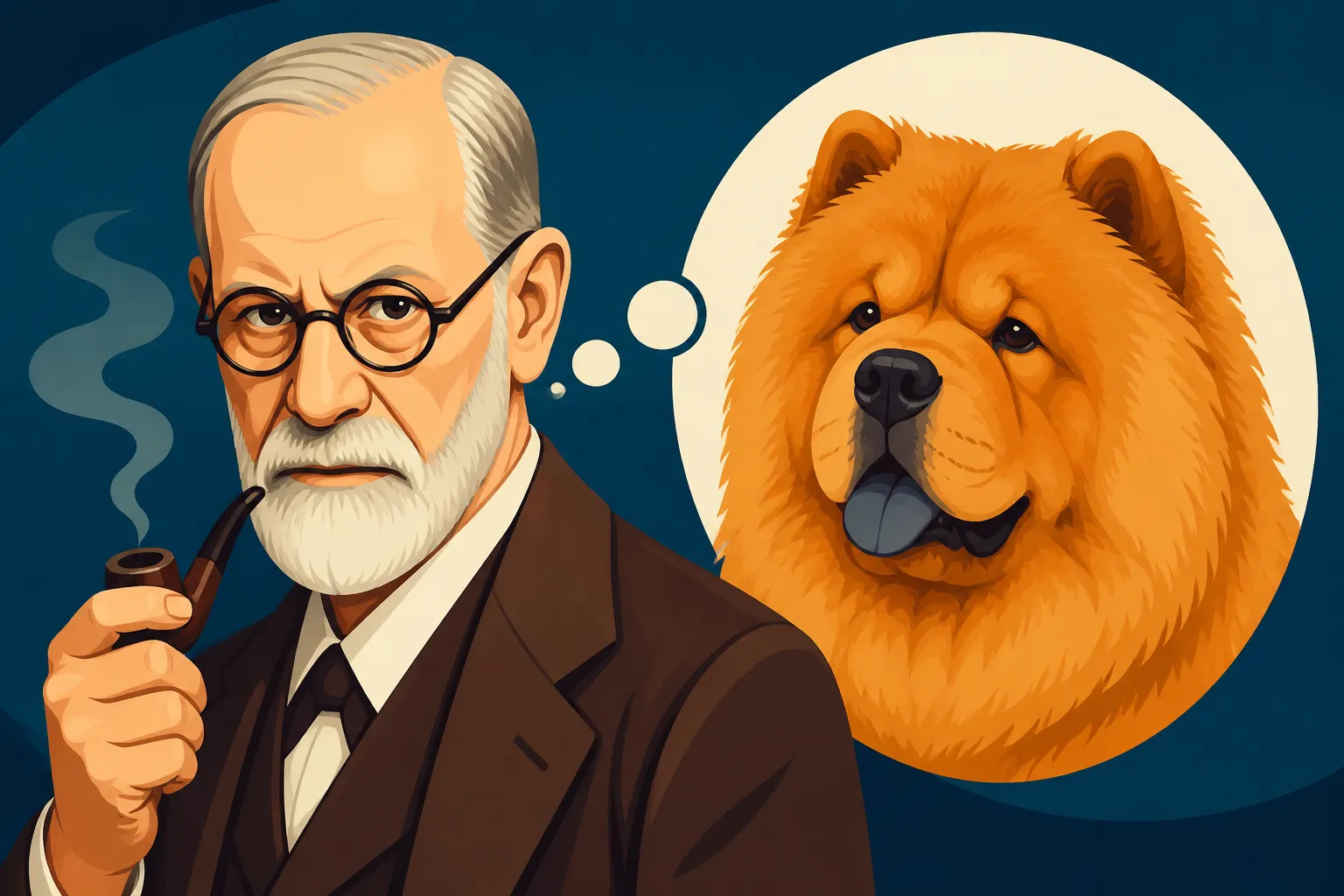
What Freud’s Chow Chow Was Called
Sigmund Freud’s best-known Chow Chow was called Jofi, a name often rendered as Yofi in English-language accounts because German “J” sounds like an English “Y.” Jofi became famous for quietly sitting in on some of Freud’s sessions. Here’s what is known about her name, her place in Freud’s life, and how the story became part of Chow Chow history.
Freud’s Chow Chow was called Jofi
Why the name also appears as Yofi
The name most commonly associated with Freud’s Chow Chow is Jofi. You may also see it written as Yofi. That variation is largely a matter of transliteration and pronunciation: in German, the letter “J” is pronounced much like the English “Y.” So a reader encountering either spelling is generally looking at the same dog, not two different Chows.
It can be confusing when searching for historical details because books and articles do not always use the same spelling. If you’re checking a reference, try both Jofi and Yofi rather than assuming one version must be incorrect. The distinction is especially useful when separating reliable biographical discussion from modern retellings that repeat the story without explaining the spelling.
Freud was associated with more than one Chow Chow over the course of his life, so it is also worth being precise about which dog a source means. Jofi is the name most closely linked to accounts of a Chow Chow accompanying Freud during his work with patients. For more background on the question of Freud’s breed, see Whether Sigmund Freud Had a Chow Chow.
Was Jofi a male or female dog?
Jofi is generally described as a female Chow Chow. That detail can get lost when the story is retold briefly, especially in passages that call the dog simply “Freud’s Chow.” The name and the dog’s role are much more commonly repeated than personal details such as sex.
Jofi is not remembered because Freud trained her to perform a formal clinical task. Rather, she was a companion who was sometimes present while he worked. Her calm, familiar presence became part of the environment in which some patients spoke with him. That is a more grounded description than saying she was a therapist or that Freud used her as a diagnostic instrument.
Freud’s household and working life included dogs, and Jofi’s story sits at the intersection of biography and the history of psychoanalysis. If you want to understand why a Chow Chow might have stood out in that setting, it helps to know a little about the breed’s distinctive character and long history. The Chow Chow Is One of the Oldest Breeds in the World offers a broader starting point.
What Jofi did during Freud’s sessions
The dog who sat quietly nearby
Accounts of Jofi describe her as being present during some of Freud’s sessions. She was not there as a trained service dog, and her presence should not be confused with modern, structured animal-assisted therapy. She was Freud’s companion, and he allowed her to remain in the room on occasions when he was seeing patients.
That small detail has become memorable because it offers a vivid picture of the setting: a patient speaking with Freud while a Chow Chow rested nearby. For some people, a quiet dog might make a room feel less formal or tense. For others, a dog in the room could be distracting or uncomfortable. There is no reason to assume every patient experienced Jofi in the same way.
The question of whether she regularly attended sessions is often discussed as if the answer were a simple yes or no. In reality, it is more careful to say that Jofi was present at times, rather than implying that every patient met her or that she was a fixed part of every appointment. The related topic Whether Freud's Chow Chow Sat In on Sessions explores that distinction.
Freud’s observations about dogs and people
Freud was interested in how people behaved, and Jofi’s presence gave him opportunities to notice how patients responded to her. Some accounts say that he interpreted her behavior as an informal cue about the atmosphere in the room. This is the part of the story most likely to grow exaggerated: it can turn into a claim that Jofi could reliably identify a patient’s character or reveal hidden truths.
A dog’s behavior can certainly change in response to sounds, movement, posture, scent, routine, or a person’s approach. But that does not make the dog a dependable reader of someone’s inner life. Jofi’s movements could have reflected ordinary canine preferences and reactions, not a clinical judgment. A careful account should keep Freud’s observations separate from claims that cannot be established from the anecdote alone.
That is why it is more accurate to describe Jofi as a dog whose behavior Freud noticed than as a tool he used to assess patients. The distinction matters when telling the story today, especially because modern readers may associate dogs in clinical settings with trained therapy animals. Whether Freud Used His Chow Chow to Read Patients considers the claim more closely.
| Question | Careful answer |
|---|---|
| What was Freud’s Chow Chow called? | Jofi, also written as Yofi |
| Was Jofi a Chow Chow? | Yes, she is widely described as Freud’s Chow Chow |
| Did she sit in on sessions? | Accounts describe her as present during some sessions |
| Was she a formal therapy dog? | No; that modern label should not be applied casually |
| Could she diagnose or read patients? | There is no sound basis for treating her behavior as a reliable diagnosis |
Why Jofi became part of Chow Chow history
A breed with a striking presence
Chow Chows are visually distinctive: they have a broad head, small upright ears, a dense coat, and a characteristic appearance that can seem serious or reserved. A dog with that look sitting quietly in the room of a famous psychoanalyst is easy to remember. Jofi’s story has therefore traveled beyond Freud biographies and into discussions of the breed itself.
The story also speaks to the breed’s independent reputation, though it should not be treated as proof that all Chow Chows behave alike. Individual temperament varies, and a dog’s behavior depends on its upbringing, health, socialization, and surroundings. Jofi was one dog in one household, not a model for every Chow Chow.
For readers exploring the breed more broadly, its history is much older and more complex than the Freud anecdote. The Chow Chow’s roots are associated with China, and its historical roles and names have been discussed in many different ways. Where the Chow Chow Comes From and What Songshi Quan Means provide more context for that background.
Separating the story from later embellishment
A compelling anecdote often becomes neater each time it is repeated. Jofi’s story is sometimes presented as though Freud deliberately brought her into every appointment because she could judge people, or as though her reactions confirmed his interpretations. Those versions turn a reported household detail into a much stronger claim.
A more measured account is still interesting. Freud had a Chow Chow named Jofi; the dog was reportedly present during some sessions; and Freud paid attention to how she behaved around people. That is enough to explain why the story has lasted without assigning Jofi powers or a professional role she did not have.
The same care is useful when reading breed history generally. Popular accounts can blend documented details with colorful retellings. For instance, the Chow Chow’s movement from China to Europe involved a longer history than any single famous owner or fashionable moment. How the Chow Chow Reached England adds another piece to that wider story.
What modern Chow Chow owners can take from Jofi’s story
A familiar dog can change the feel of a room
Jofi’s presence is a reminder that dogs are part of everyday human environments, not just subjects of training or breed descriptions. A calm companion can make a room feel more welcoming to some people, while others may prefer distance from dogs. If you bring a Chow Chow into a home with visitors, it is sensible to give both the dog and the guest space to choose whether to interact.
That is particularly important with a breed often described as reserved. Don’t assume a Chow Chow wants to be touched simply because the dog is quiet, or that a visitor understands how to approach. Give the dog a place to retreat, supervise introductions, and let the animal set the pace. Reading about the breed’s development can also help explain why its temperament is not well captured by a single famous anecdote. How the Chow Chow Differs From a Shar Pei offers a useful comparison with another distinctive breed.
The story does not replace everyday care
Jofi’s fame can send readers down a rewarding historical rabbit hole, but owning a Chow Chow today involves practical needs that Freud’s anecdote does not address. Dense coats need consistent grooming, dogs need patient handling, and health or behavior concerns should be discussed with qualified professionals. The best approach is to learn about the individual dog in front of you rather than expecting it to behave like a historical figure’s pet.
For example, a prospective owner researching brushes or coat-care supplies may compare product descriptions from retailers such as Chewy, but the right tool depends on the dog’s coat and tolerance for grooming. A Chow Chow that resists brushing may need gradual, positive handling practice rather than simply a different brush. Likewise, food choices available through Chewy should be considered in light of the dog’s age, condition, and veterinary advice, not selected because a particular product seems popular.
Chewy can be one place to browse everyday supplies, but a retailer listing cannot tell you whether a Chow Chow is comfortable with a new handling routine or whether a skin problem needs medical attention. The useful lesson from Jofi’s story is not that every Chow Chow should be expected to behave like Freud’s dog. It is that a dog’s presence can matter to people—and that understanding the individual dog matters more than repeating a charming legend.
Disclaimer
This article is for general informational purposes only and does not constitute professional advice. Laws, prices and regulations vary by location and change over time. Consult a qualified professional for guidance on your specific situation.