When the First Chow Chow Reached Britain
The first Chow Chow to reach Britain cannot be tied with confidence to a named dog or an exact arrival date. The breed is generally believed to have come to England from China in the late eighteenth century, with early imports arriving aboard merchant ships. This guide separates that likely first arrival from the better-documented story of the breed’s later public display and popularity.
When the First Chow Chow Reached Britain
The likely arrival in the late eighteenth century
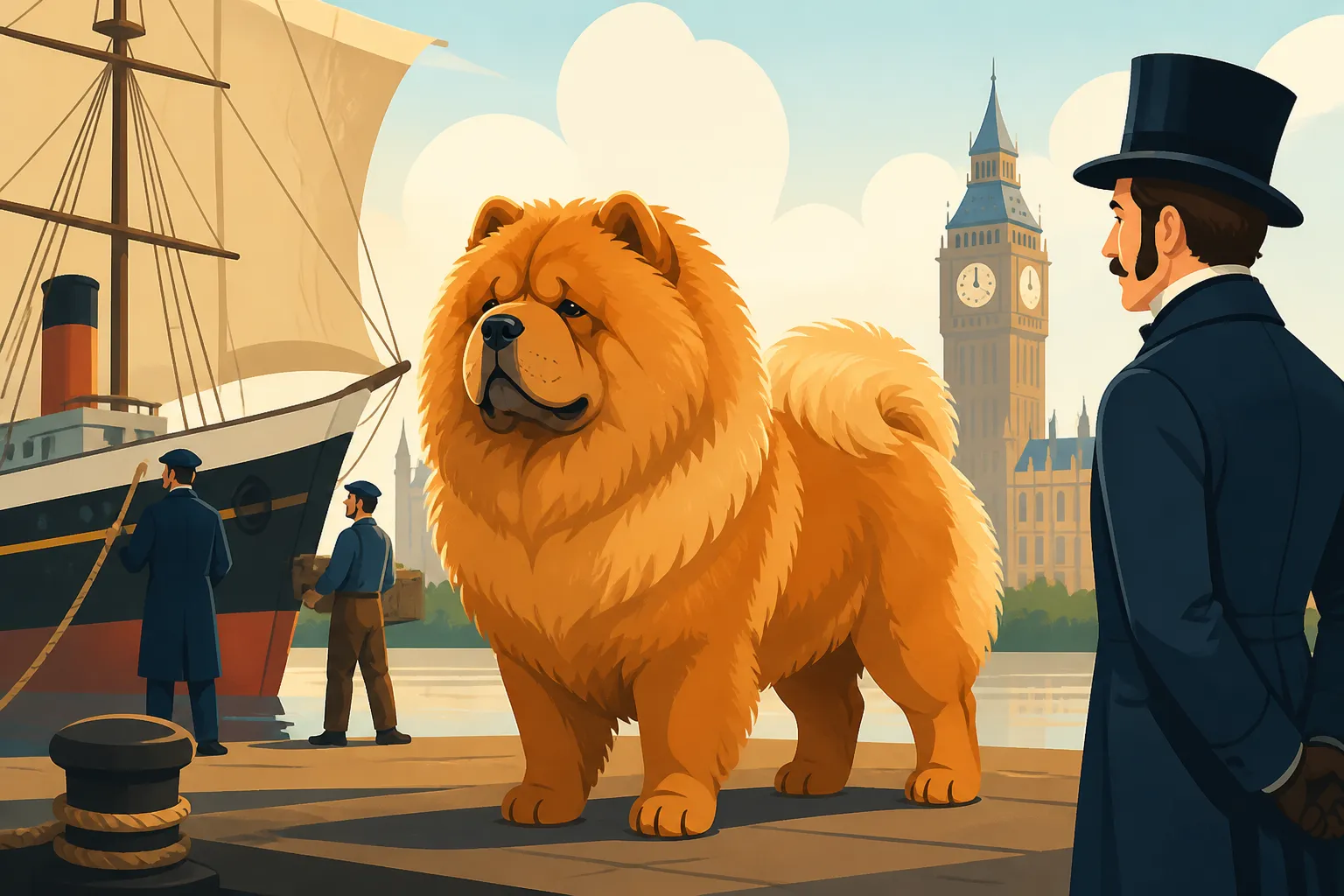
Historical accounts commonly place the Chow Chow’s arrival in Britain around the late 1700s, with some giving a date near 1780. That is a useful guide to the period, but it should not be treated as a firmly documented arrival date for a particular dog. The surviving story is about a gradual introduction of Chinese dogs to Britain, not a clearly recorded first passenger with a name, owner, and ship’s log.
Britain’s expanding maritime trade with China made it possible for unusual animals to travel west with merchants and sailors. Dogs brought back from China could attract attention as curiosities, especially if they looked and behaved differently from the familiar British breeds of the time. A Chow’s dense coat, small upright ears, broad head, and distinctive blue-black tongue would certainly have made it memorable to people who had never seen one.
The period matters because it places the breed’s first likely British arrivals well before the organized dog-show world that later helped establish breed identities. At the time, people were not necessarily using “Chow Chow” as a precise, consistent breed label in the modern sense. A dog could be described by its place of origin, appearance, or the name a seller or shipper used. That makes it harder to know whether every early reference to a “Chinese dog” meant a Chow Chow as we recognize the breed today.
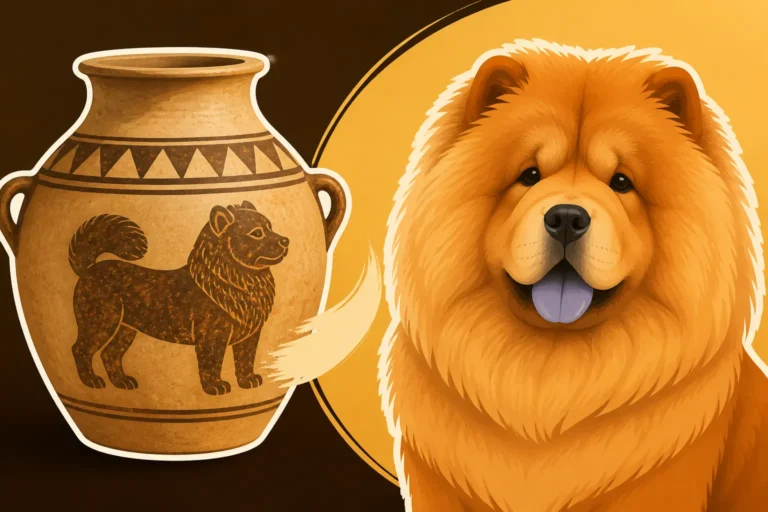
For a broader view of the breed’s background before it crossed into Britain, see Where the Chow Chow Comes From. The route to England is also part of a wider story of trade, changing terminology, and shifting ideas about what counted as a distinct breed.
Why there is no definitive “first dog” record
It is tempting to picture one clearly identified Chow Chow stepping ashore in an English port on a particular day. The evidence does not support that kind of neat story. Early imports were not necessarily recorded in the detailed way that later kennel-club registrations and show catalogues were. A ship’s paperwork might mention cargo without describing an individual dog, while a newspaper or private letter might call the animal a “Chinese dog” rather than use a breed name.
There is also a difference between the first dog to arrive and the first dog to be noticed, written about, or publicly displayed. An animal might have reached Britain privately and lived in a household for years before anyone documented it. Another might have been the first to appear in a zoo or exhibition, creating a more visible public milestone without being the first Chow ever brought to the country.
When you see a precise date attached to the breed’s arrival, it is worth asking what that date refers to. Is it a reported importation? A public exhibition? A notable owner’s dog? Or a later date repeated in breed histories? These events can all be important, but they do not answer the same question.
This distinction is central to understanding the history: the Chow Chow probably reached Britain before it became widely recognizable there. The early phase was one of scattered arrivals and curiosity; the more documented phase came later, as people began to discuss, display, and breed these dogs more systematically.
From Chinese Dogs to a Recognized Breed
What early Britons may have seen
An early visitor encountering a Chow Chow would have noticed a striking combination of traits. The dog’s thick coat could give it a rounded, almost mane-like outline, while its compact ears and broad skull contributed to a serious expression. Its dark tongue was especially unusual to observers accustomed to dogs with pink tongues. Yet appearance alone would not have told people how to classify it.
The label “Chinese dog” was broad. It could be used for dogs from China that differed considerably from one another, especially before standards and breed registries made distinctions more formal. Even within a breed, dogs vary in coat, size, color, and build. Early observers might therefore have described a Chow by general appearance or origin rather than by a stable breed name.
The name itself has a complicated history. “Chow Chow” became associated with goods and objects brought from East Asia, and its early use in Britain did not always function as a precise dog-breed label. For more on the terminology, read Where the Name Chow Chow Came From and How the Chow Chow Got an English Name From a Ship's Manifest. These histories help explain why accounts of the breed’s earliest British presence can be difficult to compare: different writers may not have been using the same label in the same way.
This does not mean early descriptions are useless. They can show that Britons encountered distinctive dogs from China and became curious about them. But a description that sounds like a Chow Chow is not automatically proof of a modern, purebred Chow. Historians and breed writers need to consider the wording, date, context, and whether the dog’s features are specific enough to support that identification.
Public display and the London Zoo
A public display offers a more visible milestone than a private import, but it should not be confused with the breed’s first arrival. The London Zoo, which opened to the public in 1828, became one place where visitors could encounter animals described as coming from China. Accounts connect Chow Chows or similar Chinese dogs with early zoo displays, sometimes under labels that sound unfamiliar by today’s standards.
A zoo label could shape public perception. Visitors who had never seen a Chinese dog might remember it as an exotic animal rather than as a companion breed. This is one reason early accounts can sound as though the Chow Chow was treated as a curiosity. The display could introduce the dog to a wider audience, even if it tells us little about how many Chows were already living in private homes.
The key point is that zoo exhibition belongs to the story of public recognition, not necessarily the first moment the breed set foot in Britain. For a closer look at that distinction, see Whether the London Zoo Displayed Chow Chows. When reading historical accounts, it helps to keep separate the date of a reported arrival, the date of a public display, and the date when a dog was clearly identified as part of a named breed.
| Historical milestone | What it helps establish | What it does not prove |
|---|---|---|
| Late eighteenth-century reports of Chinese dogs in Britain | Chinese dogs, including dogs identified with the Chow Chow, were likely arriving by this period | The exact date or identity of the first individual Chow Chow |
| Public interest in Chinese dogs during the early nineteenth century | More people could learn about or see dogs described as Chinese | That every such dog was a Chow Chow by modern breed standards |
| The London Zoo’s opening in 1828 and later displays | A public venue helped make unusual animals visible to visitors | That a zoo exhibit was the first Chow Chow brought to Britain |
| Later Victorian-era interest in dogs and dog shows | Breed identities and public attention became more organized | That the breed’s British history began only when it became fashionable |
How the Chow Chow Became Better Known in Britain
Victorian interest and influential owners
By the Victorian period, interest in dogs as companions, show animals, and symbols of status was growing. More people were paying attention to particular types and breeds, and unusual dogs could attract interest from wealthy owners and the public. The Chow Chow’s distinctive look made it especially likely to stand out in a crowded world of imported and emerging breeds.
Queen Victoria is often mentioned in accounts of the breed’s growing British profile. Her interest in dogs helped make canine ownership fashionable, and the royal association is one part of the wider story of the Chow Chow becoming more visible. Still, a well-known owner’s interest should not be mistaken for the breed’s first arrival. By the time a dog attracted royal attention, Chinese dogs had likely been reaching Britain for decades.
For more on that later stage, read When Queen Victoria Got a Chow Chow. The distinction is useful: an influential owner can increase public curiosity and help a breed gain status, but that does not establish when the first dog arrived or how many earlier dogs were in the country.
Victorian fashion also helped turn loose descriptions into firmer categories. Owners and breeders increasingly had reasons to distinguish one type from another, describe desirable features, and record lineage. The Chow Chow’s appearance could be discussed as a recognizable set of traits rather than simply as an unusual dog from China.
Breed clubs and the move toward formal identity
The modern idea of a breed depends partly on shared standards and organized breeding. Those systems were not in place when the earliest Chinese dogs likely reached Britain. Over time, breed enthusiasts began to define the Chow Chow more clearly, and clubs and shows gave people a common framework for discussing its appearance and ancestry.
The formation of a British breed club marks a later stage in this process. It reflects a shift from occasional curiosity toward a more organized community of owners and breeders. This period also makes the historical record easier to follow, because club activity, show participation, and written standards leave more trace than private imports did. See When the First British Chow Chow Club Formed for more on that development.
A formal breed identity does not mean that every dog’s ancestry was perfectly documented, nor does it erase the uncertainty around the first arrival. Instead, it gives us clearer evidence about when people in Britain began treating the Chow Chow as a distinct breed with shared characteristics. That is a different but important milestone in the breed’s history.
The timeline is therefore best understood as a series of stages: likely early imports from China, increasing public visibility, growing interest among prominent owners, and eventually organized breed recognition. Each stage adds something to the story, but none should be substituted for the others.
How to Read Claims About the First Chow Chow in Britain
Separate arrival, recognition, and popularity
When a source says the Chow Chow “came to Britain” on a particular date, check what event it is describing. It may refer to an early import, the first known public display, a prominent owner’s dog, or a period when the breed became more popular. Those events can be separated by many years, and compressing them into one date makes the history sound more certain than it is.
A helpful way to assess a claim is to look for the details behind it. Does the account name the dog, its owner, the ship, or the port? Does it quote a contemporary document, or does it repeat a date without explaining where it came from? The more specific the evidence, the more clearly you can tell whether the date describes an individual arrival or a broader historical turning point.
Be cautious with wording that treats “Chinese dog” and “Chow Chow” as interchangeable in every historical record. The modern breed name can be applied retrospectively, but the identification may be more or less secure depending on how much detail the original description provides. A dog described only by its place of origin is harder to identify than one described with several distinctive physical characteristics.
This careful reading is not nitpicking. It makes the history more interesting, because it shows how the Chow Chow moved from being an unfamiliar imported dog to a recognizable British breed. It also helps explain why two accounts can give different dates without necessarily contradicting one another: they may be describing different milestones.
The most balanced answer to the question
The most balanced answer is that Chow Chows likely reached Britain in the late eighteenth century, with commonly repeated accounts placing early arrivals around that time. However, the exact first dog and its arrival date are not firmly established by a clear, widely documented record. The breed became more visible later through public interest, displays, prominent owners, and eventually organized breeding.
That answer may feel less satisfying than a single date, especially when you are trying to pin down a clean timeline. But it is more useful than presenting a confident year without explaining what it represents. In historical research, uncertainty about one individual event can coexist with a credible understanding of the larger pattern.
The breed’s British story is not only about when the first dog arrived. It is also about how people recognized it, named it, and began to treat it as a distinct breed. A likely late-eighteenth-century arrival begins the story; the nineteenth-century public and organized life of the Chow Chow gives it shape.
For the next milestone in the breed’s overseas history, see When the First Chow Chow Reached America. Comparing the British and American timelines can help show how the breed’s movement across the world unfolded in stages rather than through one dramatic, easily documented moment.
Disclaimer
This article is for general informational purposes only and does not constitute professional advice. Laws, prices and regulations vary by location and change over time. Consult a qualified professional for guidance on your specific situation.