Whether the Chow Chow Was Ever a War Dog
A Chow Chow’s imposing build and watchful nature can make it easy to picture the breed marching into battle beside an ancient army. But the historical record is less dramatic: there is no strong evidence that Chow Chows served as a distinct, organized war-dog breed. This guide separates plausible guard and hunting roles from the much bigger claim that they were battlefield dogs.
Was the Chow Chow used as a war dog?
What the historical record can and cannot show
The Chow Chow has deep roots in China, but its early history is difficult to reconstruct with the certainty modern readers might expect. Images, later descriptions, and traditions can suggest that dogs resembling Chow Chows lived and worked in China long ago. They do not necessarily identify a dog by modern breed standards, or establish one precise job for every dog of that type.
That distinction matters when asking whether the Chow Chow was ever a war dog. A dog that guarded a home, accompanied a hunter, or lived near a military camp might encounter danger or people in uniform. That does not automatically make it a purpose-bred battlefield dog. A convincing claim of formal military service would require clearer evidence that dogs identified as Chow Chows were deliberately trained, organized, or recorded for combat duties.
For Chow Chows specifically, that kind of evidence is thin. Historical claims about the breed’s ancient roles tend to focus more on hunting, guarding, and life around people than on a defined military function. The careful answer is therefore not that a Chow Chow could never have been present in a conflict, but that the breed is not well documented as a specialized war dog.
Why the question keeps coming up
A Chow Chow has a broad head, a dense coat, a sturdy body, and a serious expression. Those features can make the breed look formidable, especially in old-fashioned illustrations or descriptions of Chinese dogs. It is easy for a modern reader to see a strong-looking dog and assume it was used for fighting or warfare.
The breed’s long history also invites grand claims. The further back a dog’s origins are placed, the more tempting it can be to assign it a dramatic role in every part of ancient life. Yet a dog’s age as a type does not prove that it served in a particular military capacity. “Ancient” and “war dog” are separate claims, and each needs its own evidence.
A related confusion is the broad use of the word “war dog.” It can mean a dog trained to attack, a sentry dog guarding a camp, a messenger or supply dog, or simply a dog that lived during wartime. Those are very different roles. The Chow Chow’s reputation as a capable guardian may make the sentry interpretation seem plausible, but plausibility is not the same as a documented, breed-specific history.
What roles are more plausible for Chow Chows in China?
Hunting and working alongside people
Chow Chows are often associated with hunting in accounts of their traditional history. The details of how the breed’s ancestors were used are not always precise, and historical dogs did not necessarily match today’s purebred Chow Chow in every physical or behavioral detail. Still, hunting is a more commonly discussed working context than battlefield combat. For more on that subject, see What Game a Chow Chow Was Used On.
A hunting dog’s work could demand stamina, confidence, and the ability to stay close to people in challenging surroundings. That can help explain why a sturdy dog might have been valued without implying it was trained to attack human opponents. A dog can be useful on a hunt because it helps locate or pursue game, or because it accompanies people as they travel; none of those tasks is military service.
Historical references to an emperor’s dogs can add to the impression of an official role, but courtly use does not automatically mean warfare. The distinction between a hunting companion, a prestigious household dog, and a trained combat animal is important. What a Chow Chow Did for a Chinese Emperor explores the kinds of imperial associations that can contribute to this confusion.
Guarding homes, temples, and transport
A guardian role is also plausible. Dogs have long been kept to alert people to unfamiliar visitors or activity, and a watchful, independent dog could have been useful around property. That is different from being trained to fight in an army. Alerting, deterring, and protecting a place are forms of guarding, but they do not establish a formal war-dog tradition.
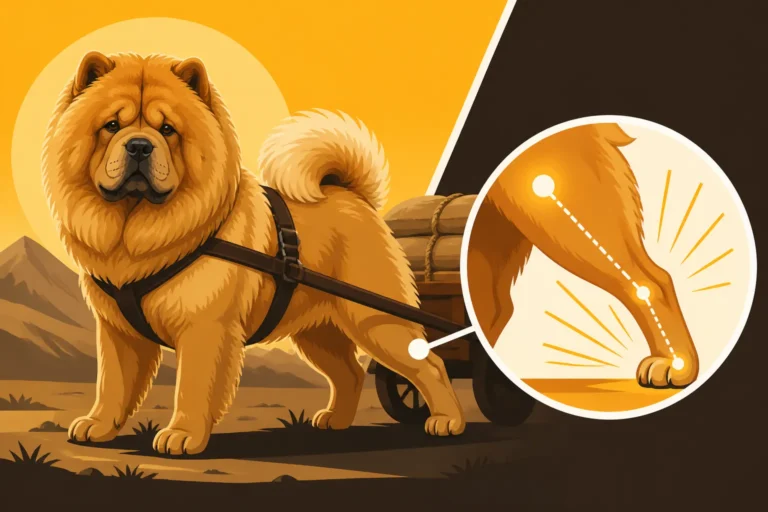
Stories and discussions about Chow Chows sometimes connect them with temples, boats, carts, or other settings where a dog might have helped guard people and belongings. These settings may reflect the broader jobs dogs performed rather than a single, well-documented Chow Chow assignment. You can read more about these claims in Whether Chow Chows Guarded Temples and Whether Chow Chows Guarded Junks and Carts.
The same caution applies to the breed’s association with powerful owners or wealthy households. A dog kept by a noble family might have been a companion, a guard, a hunting dog, or a combination of roles. It does not follow that every dog in such a household served in battle. Whether the Chow Chow Was a Nobleman's Dog Only offers more context on the breed’s social associations.
| Claim about the Chow Chow | What it can reasonably suggest | What it does not prove |
|---|---|---|
| The breed has ancient roots in China | Dogs resembling Chow Chows have a long historical background | That the modern breed served in a specific army |
| Chow Chows are associated with guarding | Some dogs may have alerted or guarded around people and property | That they were trained for battlefield combat |
| Chow Chows are associated with hunting | Dogs of this type may have worked with hunters | That hunting work was military service |
| A dog lived during a war or near soldiers | It may have encountered conflict or guarded a location | That it was an organized war dog |
| Historical accounts describe Chinese military dogs | Dogs were used in warfare in some contexts | That those dogs were specifically Chow Chows |
How a war dog differs from a guard dog
Guarding is not the same as combat
A guard dog’s primary purpose is usually to notice something unusual and respond in a way that alerts or deters. It may bark, stand its ground, or remain near the person or place it is expected to protect. A dog with a strong sense of territory could be valued for those traits in a household or at a work site.
A war dog, in the more specific sense, is deliberately used in an armed conflict. Depending on the period and culture, that might involve guarding a camp, carrying messages, scouting, or attacking. To call a breed a war dog, it is helpful to know which role is meant and whether there is evidence that the breed was actually trained or deployed for it.
This is why describing the Chow Chow as a “guardian” is more careful than calling it a “warrior.” Guarding a home or a cart could be a real and useful job without requiring a claim about battlefield training. The broader history of the breed’s origins and working associations is discussed in Where the Chow Chow Comes From.
Why a dog’s appearance is not historical proof
The Chow Chow’s substantial coat and sturdy outline can make it seem suited to harsh conditions. But appearance alone cannot tell us what job a dog performed. A thick coat does not prove a dog was taken on military campaigns, and a watchful expression does not establish that it was trained to attack.
Temperament should be treated with the same care. Chow Chows can be reserved and independent, but individual dogs differ, and modern breed tendencies do not provide a complete record of ancient behavior. Even if a dog was naturally protective, that would not prove that people used it as a weapon or assigned it a military role.
There is also a tendency to interpret old references through modern categories. A historical description of a large, strong, or protective dog may be translated into a familiar modern label such as “war dog,” even when the original role is uncertain. Without a clear account of training and use, it is safer to describe the reported task rather than apply a dramatic label.
How to evaluate claims about the Chow Chow’s military past
Look for a specific role and a specific source
When you encounter a claim that Chow Chows were war dogs, ask what the phrase means in that context. Does the account say they guarded a location, accompanied a ruler, hunted, or fought? If it only says they were “used in war,” without explaining how or identifying the dogs clearly, the claim may be repeating an assumption rather than giving a well-supported history.
It also helps to ask whether the account distinguishes between the modern Chow Chow and older regional dogs that may have looked similar. Breed identities and standards changed over time, so a historical reference to a Chinese dog is not automatically proof that it was a Chow Chow in the modern sense. The more specific the claim, the more specific the evidence should be.
Finally, consider whether the claim is repeated with additional detail or simply copied from one short description to another. Repetition can make an uncertain story sound settled. A careful account will signal what is known, what is inferred, and where the evidence does not allow a firm conclusion.
A sensible way to describe the breed’s past
For a general reader, the most accurate phrasing is that Chow Chows have historical associations with China and are commonly connected with guarding and hunting, while a distinct role as organized battlefield war dogs is not firmly established. This wording leaves room for the possibility that dogs resembling Chow Chows were present around soldiers or during conflicts without turning that possibility into a proven breed history.
That answer may feel less exciting than a tale of an ancient canine warrior, but it is more useful. It prevents a plausible working role from becoming an unsupported legend and respects the difference between a dog that could guard and a dog that was formally deployed in combat.
So, was the Chow Chow ever a war dog? It is possible that individual dogs lived near military activity or helped protect people and property in turbulent times. But the evidence does not clearly establish the Chow Chow as a recognized, specialized war-dog breed. Its more defensible historical image is that of a versatile Chinese dog associated with hunting, guarding, and human households. For another perspective on how working roles are sometimes inferred, see Whether the Chow Chow Was Ever a Draft Dog and How the Chow Chow Reached England.
Disclaimer
This article is for general informational purposes only and does not constitute professional advice. Laws, prices and regulations vary by location and change over time. Consult a qualified professional for guidance on your specific situation.