Which Breeds Went Into the Eurasier
The Eurasier was deliberately developed in Germany by combining three northern-type breeds, but the story is easy to blur because its first name highlighted only two of them. This guide explains how the Chow Chow, Wolfspitz, and Samoyed contributed, how the breeding sequence unfolded, and what that ancestry does—and does not—tell you about a Eurasier today.
The three breeds behind the Eurasier
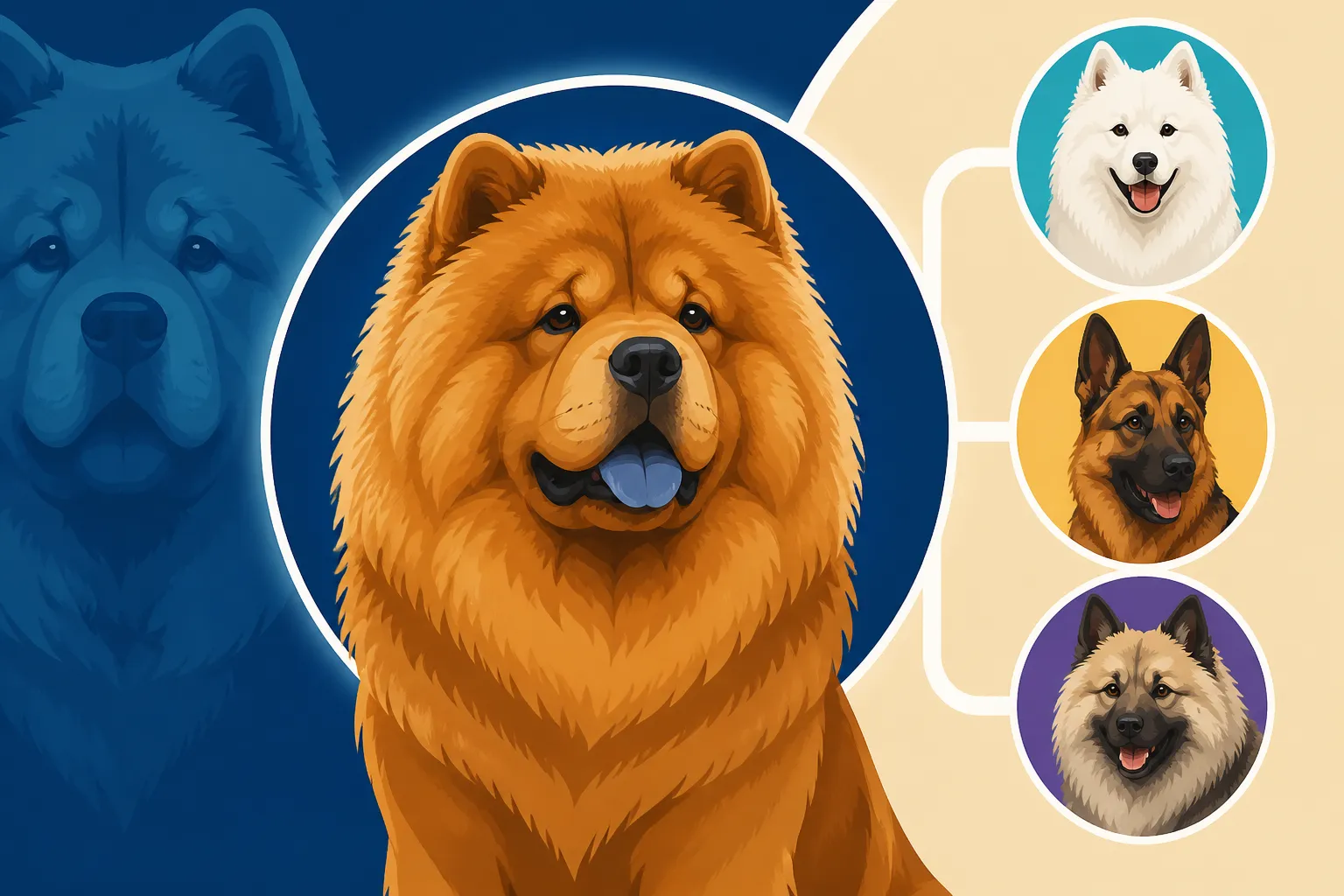
The Eurasier’s foundation breeds were the Chow Chow, the Wolfspitz, and the Samoyed. The first two were crossed in the breed’s early development; the Samoyed was introduced later. That order matters: the Eurasier was not simply created by crossing all three breeds at once.
The breed was developed in Germany in the 1960s under the guidance of Julius Wipfel and other early breeders. Their aim was to establish a companion dog with a recognizable northern-spitz appearance and a temperament suited to family life. The breed’s development involved planned breeding over generations, not one isolated pairing.
Chow Chow: one of the foundation breeds
The Chow Chow contributed to the early breeding program that produced the Eurasier. Its ancestry is also part of why the Eurasier’s development is sometimes described as a combination of “Chow” and “Wolfspitz.” The Chow Chow itself has a long history, and exploring Where the Chow Chow Comes From and How Old the Chow Chow Breed Is helps put that part of the Eurasier’s background in context.
A breed’s contribution does not mean that every puppy inherits a neat, predictable set of traits from that ancestor. In a developing breed, breeders select dogs across generations for particular qualities, and inherited characteristics can vary. A Eurasier may share features or tendencies with its foundation breeds without behaving like a Chow Chow in every respect.
The Chow Chow is often described as independent and reserved, but individual dogs differ, and early socialization and upbringing matter. It is more useful to think of the Chow Chow as one influence in the Eurasier’s history than to assume the Eurasier is simply a Chow Chow with a different coat or name. For a closer comparison of appearance and temperament, see How a Chow Chow Differs From a Eurasier.
Wolfspitz: the other early foundation
The Wolfspitz was the second breed used in the early crosses. In North America, this variety is commonly known as the Keeshond; naming conventions can vary by country and kennel organization. That’s one reason accounts of Eurasier ancestry may use “Wolfspitz” in one place and “Keeshond” in another.
The Wolfspitz brought another northern-spitz influence into the developing breed. Eurasier histories often describe the early combination as a Chow Chow and Wolfspitz cross. The breed was initially known as the Wolf-Chow, a name reflecting those two early contributors. To learn more about the Chow Chow’s relationship to the Keeshond, see How a Chow Chow Differs From a Keeshond.
That shared ancestry does not make the Eurasier and Keeshond interchangeable. They are distinct breeds with different histories and breeding goals. A family comparing the two should look at the individual dog, the breeder’s priorities, and the kind of daily companionship they want—not just the fact that both have northern-spitz roots.
Samoyed: introduced later
The Samoyed was introduced after the initial Chow Chow–Wolfspitz crosses. Its addition helped shape the developing breed, and the name Eurasier eventually reflected the aim of bringing together European and Asian influences. The sequence is worth remembering: Chow Chow and Wolfspitz came first; Samoyed followed as part of the continued development.
It’s tempting to explain each Eurasier characteristic by assigning it to one ancestor: a certain coat quality to one breed, a certain temperament to another. That can be an appealing shortcut, but a breed is not a simple recipe where each ingredient produces one guaranteed result. Traits are inherited in complex ways and shaped by generations of selection.
The Samoyed’s role is therefore best understood as part of a deliberate breeding program, not as proof that every Eurasier will have a particular Samoyed-like feature. The breed’s history helps explain its foundation, while a dog’s actual health, temperament, and appearance depend on more than a label in its pedigree.
How the breeding sequence unfolded
The Eurasier’s history is a process rather than a single cross. Early breeders began with Chow Chows and Wolfspitz, then continued selecting and breeding dogs to establish a consistent type. The Samoyed was added later, and the breed came to be known as the Eurasier.
From Wolf-Chow to Eurasier
The first name, Wolf-Chow, pointed directly to the two breeds used in the early stage. As the breeding program developed and the Samoyed was incorporated, the name Eurasier better reflected the broader ancestry and the breed’s identity as a distinct companion dog.
The change in name does not mean the original foundation breeds became irrelevant. It reflects how the breeding project evolved: the early crosses provided a starting point, while later generations were selected to create a stable breed rather than a collection of mixed-breed dogs.
That distinction matters when people ask whether a Eurasier is “part Chow Chow.” Historically, yes: the Chow Chow was one of its foundation breeds. But a modern Eurasier is a recognized breed with its own standard and breeding history, not an individual Chow Chow mix. For another look at how Chow Chow relationships are described, see Which Breeds the Chow Chow Is Most Related To.
Why a planned breed is different from a casual cross
A planned breed develops over generations. Breeders choose which dogs to pair, evaluate the resulting puppies, and continue selecting for a set of desired qualities. A casual cross, by contrast, may have no long-term plan to establish consistent traits or a distinct population.
This does not mean every dog in a planned breeding program will be identical. No breed produces perfectly uniform dogs, and responsible breeding still involves assessing health, temperament, and the suitability of individual dogs. But the goal is greater consistency over time than you would generally expect from a one-off cross.
For prospective owners, this means that knowing the ancestry is a useful starting point, not a guarantee. If you’re looking at a puppy, ask about the parents’ health and temperament, how the puppies are raised, and what support the breeder provides. A breed name alone cannot answer those questions.
What the ancestry can tell you—and what it cannot
The three foundation breeds explain the Eurasier’s origin, but they do not provide a complete forecast of an individual dog. It helps to separate historical facts from assumptions about what a Eurasier will look or act like.
| Question | What the breed history supports | What it does not guarantee |
|---|---|---|
| Which breeds founded the Eurasier? | Chow Chow and Wolfspitz were crossed first, with Samoyed added later. | That each dog will visibly resemble all three breeds. |
| Is a Eurasier a Chow Chow mix? | The Chow Chow was one of the breed’s historical foundation dogs. | That a modern Eurasier is simply an individual crossbred dog. |
| Does ancestry predict temperament? | The breed was developed with a companion-dog purpose. | That every Eurasier will be equally outgoing, reserved, or easy to train. |
| Does ancestry determine care needs? | A thick coat and northern-type background make grooming and climate awareness relevant. | That every dog will have identical coat, health, or exercise needs. |
Appearance is not a simple family tree
Eurasiers are generally recognized as medium-sized, spitz-type dogs with a dense coat and a curled tail. Their appearance can remind people of one or more of their foundation breeds, but resemblance is not a reliable way to measure how much of each breed an individual dog “looks like.”
Coat color, facial shape, body proportions, and expression vary. Even within a breed, puppies from the same litter may not look exactly alike as adults. A puppy’s coat also changes as it matures, so a young dog’s appearance may not be a perfect preview of its adult coat.
If a particular feature is important to you, ask the breeder about the parents and previous litters, and meet adult dogs when possible. Comparing photos can be helpful, but it should not replace seeing how the dogs move and behave in person. The Chow Chow’s distinct appearance is explored in Five Colors and Nothing Else: the Chow Chow Palette, but a Eurasier should be evaluated as its own breed.
Temperament takes more than ancestry
The Eurasier was developed as a companion breed, but that does not mean every individual will have the same social style. Dogs may differ in how quickly they warm up to visitors, how much handling they enjoy, and how they respond to unfamiliar places. Early experiences and thoughtful socialization also help shape behavior.
For example, one Eurasier may calmly observe guests from across the room before choosing to approach, while another may be more immediately engaged. Neither response can be explained by ancestry alone. A responsible breeder should be able to talk about the temperament of the parents and the ways puppies are introduced to ordinary sights, sounds, and handling.
If you are choosing a puppy, focus on the dog and the breeding environment rather than expecting a particular foundation breed to dictate personality. Ask what the breeder has observed in each puppy, how they match puppies to homes, and what kind of ongoing guidance they offer.
What prospective owners should ask
Learning the Eurasier’s origins is useful, but it is only one part of researching the breed. A strong decision also depends on the dog’s day-to-day needs, the breeder’s practices, and whether the breed fits your household.
Questions for a breeder
Start by asking the breeder to explain the breed’s history in their own words. They should be able to describe the Chow Chow and Wolfspitz foundation, the later addition of the Samoyed, and how the breed developed into a distinct companion dog. Clear answers help you distinguish breed history from marketing claims.
Then ask about health screening and temperament. Find out what health information is available for both parents, how the breeder assesses the dogs’ behavior, and what support is available if questions arise after a puppy goes home. The answer should be specific to the dogs in front of you, not just a general statement that the breed is healthy or easy to live with.
It is also reasonable to ask about grooming and routine supplies. A Eurasier’s coat needs regular attention, and the right brush or comb depends on the coat and the dog’s tolerance for grooming. If you compare grooming tools or food options through a retailer such as Chewy, use the product information as a starting point and confirm diet decisions with your veterinarian. Chewy can also be one place to compare everyday supplies, but a retailer’s listing cannot replace advice tailored to your dog.
Researching daily life, not just origin
A breed’s history can tell you why it exists, but it cannot tell you whether it suits your schedule. Think about how much time you can give to grooming, training, exercise, and companionship. A dog that looks like a perfect match in a photograph may be a poor fit if its practical needs do not work for your household.
Consider the climate where you live, too. A dense coat can require careful management in warm weather, and every dog needs access to shade, fresh water, and a comfortable place to rest. Ask breeders how they manage coat care and help their dogs stay comfortable in the seasons where they live. When assembling supplies, Chewy may help you compare items such as grooming tools, but choose equipment based on your dog’s coat and comfort rather than buying a large kit automatically.
Finally, meet adult Eurasiers if you can. Ask owners what surprised them, what takes the most effort, and what they appreciate about living with the breed. Their experience will not predict your future dog exactly, but it can add valuable everyday detail to the historical story. Chewy may be useful for browsing routine pet-care products after you bring a dog home; it is not a substitute for a breeder, veterinarian, or breed club when you need guidance about ancestry or health.
Disclaimer
This article is for general informational purposes only and does not constitute professional advice. Laws, prices and regulations vary by location and change over time. Consult a qualified professional for guidance on your specific situation.