Why a Slicker Alone Will Not Reach a Chow Chow’s Skin
If you're a Chow Chow owner, you know the struggle: you brush and brush, and your majestic companion looks absolutely gorgeous on the surface. But then you run your fingers through their dense fur, and dread washes over you – right down by the skin, there’s a mat forming, or worse, a tightly felted patch you swear wasn't there yesterday. The truth is, while a slicker brush can make the topcoat look tidy, it often doesn't penetrate the Chow Chow's incredibly thick double coat, leaving the real work untouched and deep mats to develop. This guide will explain why a slicker alone isn't enough and what tools and techniques you really need to keep your Chow's coat healthy and mat-free.
Understanding the Chow Chow's Unique Coat
The Chow Chow’s coat is nothing short of magnificent, but it's also a marvel of natural engineering designed for harsh climates. It’s a double coat, meaning it has two distinct layers, each with its own purpose, and each demanding different attention during grooming. If you don't understand these layers, you'll always be fighting a losing battle against mats and discomfort for your dog.
First, there's the outer coat. These are the long, coarse, and rather stiff guard hairs that give the Chow Chow its distinctive lion-like ruff and voluminous appearance. These hairs are designed to protect against rain, snow, and physical abrasion. They're like a natural shield, shedding water and dirt, and keeping the elements from reaching the dog's skin. This outer layer is what most people see and what often gets the most attention during a quick brush, creating the illusion of a well-groomed dog.
Beneath this impressive outer layer lies the truly challenging part: the undercoat. This is a soft, dense, woolly, and incredibly thick layer of insulating fur. Its primary job is to keep your Chow Chow warm in cold weather and, surprisingly, to help regulate their body temperature in warmer conditions by providing a layer of air circulation when properly maintained. It's this undercoat that sheds profusely, especially twice a year during their "coat blow" seasons. When this dead undercoat isn't removed, it quickly compacts and intertwines with the live hair, forming those dreaded, painful mats that sit right against the skin. Many owners are surprised by What a Chow Chow's Double Coat Is Made Of and just how much grooming effort is truly required to keep both layers healthy.
The Limitations of a Slicker Brush for Deep Grooming
It’s easy to fall into the trap of thinking a slicker brush is your main grooming tool for a Chow Chow. After all, it’s often recommended for double-coated breeds, and it certainly does something. You run it over your Chow, and you pull off a good amount of loose hair, leaving the topcoat looking smooth and fluffy. The immediate visual reward is quite satisfying, which only reinforces the idea that you’re doing a great job.
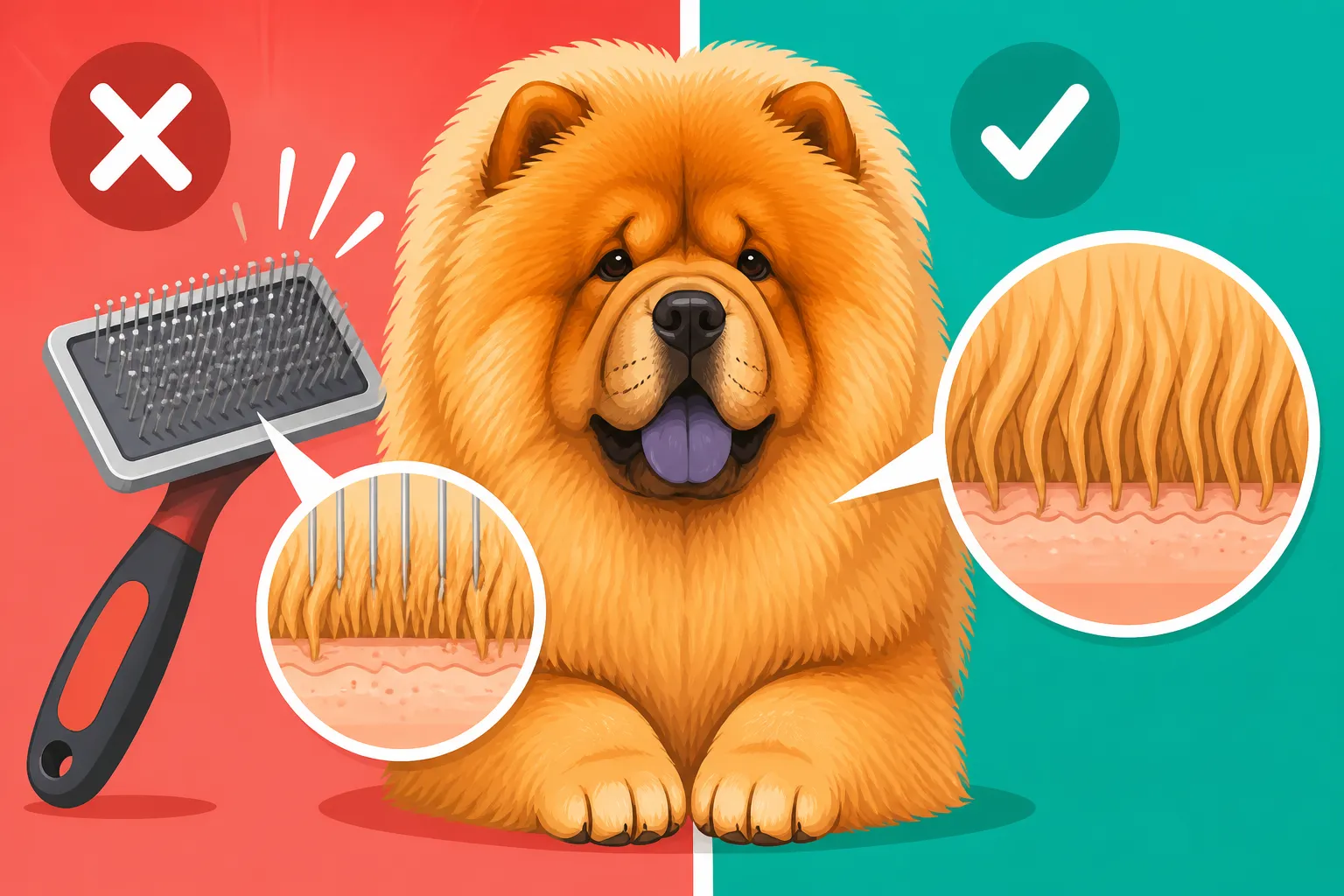
However, the design of a slicker brush fundamentally limits its effectiveness on a Chow Chow's dense undercoat. Slicker brushes have many fine, bent wire pins set closely together. They are excellent for de-tangling surface knots, smoothing the outer coat, and removing loose guard hairs. They pick up the superficial stuff admirably. But herein lies the problem: the Chow Chow's stiff outer guard hairs and extremely thick undercoat often prevent the slicker's pins from penetrating all the way down to the skin. Imagine trying to rake dry leaves off a thick, overgrown lawn with a fine-toothed comb – you’ll only get the top layer, and the dense grass beneath remains untouched.
What often happens is that the slicker brush simply skims over the surface of the undercoat, compressing any loose, dead hair further down rather than lifting it out. This creates an insidious situation where the outer coat appears perfectly fine, but underneath, closer to the skin, the dead undercoat is silently compacting, twisting, and knotting into tight, painful mats. These mats not only pull on the skin but also trap moisture and debris, creating a breeding ground for skin irritations and hot spots, especially during humid weather. It becomes particularly problematic during a When a Chow Chow Blows Its Coat, when the sheer volume of shedding undercoat overwhelms a slicker's capabilities. You might think you're brushing regularly, but if you're not reaching the skin, those mats are forming, and you won't realize it until they're large, tight, and incredibly difficult, if not impossible, to brush out without causing significant discomfort to your dog.
Essential Grooming Tools for a Healthy Chow Chow Coat
Since a slicker brush simply doesn't cut it for a Chow Chow's unique coat, you need to arm yourself with a few specialized tools that can penetrate that dense fur and get down to the skin where mats begin. Investing in the right equipment from the start will save you countless headaches, vet visits for mat removal, and ultimately, keep your Chow Chow much more comfortable. Many of these essential items can be found readily on platforms like Amazon or specialized pet retailers such as Chewy.
First up is a good quality pin brush. This isn't your primary detangling tool, but it's excellent for working through the longer guard hairs without pulling. It helps to separate the topcoat, making it easier for other tools to follow. Think of it as your first pass, preparing the way.
The real hero for a Chow Chow’s undercoat is an undercoat rake. These tools are specifically designed with longer, widely spaced teeth that can reach through the guard hairs and into the dense undercoat. They effectively pull out loose, dead undercoat without damaging the healthy outer coat. There are various types, some with rotating teeth, which can be gentler and prevent snagging. An undercoat rake is indispensable, especially during those heavy shedding seasons, to truly thin out the dead insulating layer that would otherwise mat. Owners often ask Whether an Undercoat Rake Suits a Chow Chow, and the answer is a resounding yes, it's crucial.
Next, you absolutely need a sturdy, wide-toothed metal comb. This isn't just for styling; it's your final check. After using the pin brush and undercoat rake, you should be able to run this comb smoothly through the coat, from the skin all the way to the ends, without meeting any resistance. If the comb snags, it means you've missed a tangle or mat, and you need to go back with your rake until it passes through freely. This comb is key to ensuring your hard work has actually reached the skin. Knowing Which Comb Finds a Chow Chow's Mats is vital for this final check.
Finally, while not a brushing tool, a high-velocity dryer is a game-changer for Chow Chow owners. This isn't your average human hairdryer; it blasts air at a high speed, helping to force out loose undercoat. Using it after a bath, or even between baths, can dramatically reduce shedding and prevent matting by blowing out dead hair that brushing alone can't entirely remove. It also ensures the dense coat is thoroughly dry, preventing skin issues. Many find it's the fastest way to How to Get a Chow Chow Through a Coat Blow Faster and helps loosen up that shedding undercoat.
Mastering the Technique: Line Brushing for Your Chow Chow
Having the right tools is only half the battle; knowing how to use them effectively is the other, more crucial half. For a Chow Chow, you can’t just haphazardly brush the top of their coat. You need a systematic approach to ensure you reach all the way down to the skin. This technique is called line brushing, and it's the gold standard for grooming double-coated breeds.
Line brushing involves working on small sections of the coat at a time, effectively parting the fur to expose the skin at the base of the hair shaft. You start by picking a small area, perhaps along the flank or leg, and using one hand to lift and hold up the bulk of the coat above that section. This creates a "line" of hair that you can now work on.
With the other hand, you take your undercoat rake and gently, yet firmly, brush downwards and outwards from the skin. The goal is to feel the teeth of the rake reach the skin as you brush. You'll make several passes on this small section, lifting out all the loose undercoat. Once that section feels smooth and you can easily run your metal comb through it from skin to tip, you can drop a little more of the upper coat down to create a new "line" and repeat the process.
It's a methodical, time-consuming process, but it's the only way to ensure you're truly removing dead undercoat and preventing mats from forming deep within the layers. You'll work your way across the entire body – from the neck and the impressive ruff, down the back, across the flanks, and especially the challenging areas like the britches (the fluffy fur on their rear legs), armpits, and behind the ears. These are common matting hotspots, so pay extra attention there. For instance, Why a Chow Chow's Ruff Mats Behind the Ears is a constant concern because of friction and moisture. And never forget the beautiful, thick fur on their rear legs; Why a Chow Chow's Britches Mat First is a common complaint among owners.
Consistency is key here. A thorough line brushing session at least once a week, ideally more often during coat blows, is far more effective than sporadic, superficial brushing. It not only keeps your Chow Chow comfortable but also allows for proper air circulation to the skin, which is vital for preventing skin issues and keeping them cooler. You might find a conditioning spray, like those often available on Chewy or Ollie's product line, helps the comb glide more smoothly through the coat, especially when working on a dry coat between baths.
This diligent process ensures that when you run that metal comb through their entire coat, it glides freely, confirming that you've truly addressed all layers. It’s a labor of love, but the reward is a healthy, happy, and mat-free Chow Chow.
Here’s a quick overview of the essential tools and their roles:
| Grooming Tool | Primary Function for a Chow Chow | When to Use It |
|---|---|---|
| Pin Brush | Detangles surface knots, separates guard hairs, preps coat. | Initial pass, daily light brushing, between serious sessions. |
| Undercoat Rake | Penetrates to skin, removes loose, dead undercoat. | During line brushing, 2-3 times a week, daily during coat blow. |
| Wide-toothed Metal Comb | Checks for missed mats, ensures skin-to-tip clearance. | Final check after raking, throughout line brushing to confirm depth. |
| High-Velocity Dryer | Blasts out dead undercoat, thoroughly dries dense coat to the skin. | After baths, periodically between baths to aid shedding. |
| Slicker Brush | Smooths topcoat, removes superficial loose hair. | For light touch-ups, after thorough line brushing (never alone). |
Don’t get discouraged if grooming feels like a huge undertaking at first. It absolutely is! But with the right tools and a consistent approach, you’ll become a pro at managing your Chow Chow’s spectacular coat, ensuring they are not only beautiful but also comfortable and healthy.
Disclaimer
This article is for general informational purposes only and does not constitute professional advice. Laws, prices and regulations vary by location and change over time. Consult a qualified professional for guidance on your specific situation.