Whether Shar Peis and Chow Chows Are Related
People often notice that Shar Peis and Chow Chows share a Chinese heritage, a blue-black tongue, and a distinctive, self-possessed look, then wonder whether one breed came from the other. The short answer is that they are related in a broad historical and genetic sense, but there is no solid basis for calling one a direct ancestor of the other.
How Shar Peis and Chow Chows Are Related
Both breeds have roots in China
The Chow Chow and the Shar Pei are both Chinese breeds, but their histories are not equally well documented. Chow Chows have a long history in China, and dogs resembling them appear in historical accounts and artwork. The Shar Pei is also associated with China, though details about its early development and original role are less certain.
That shared geography matters: dogs living in the same broad region over a long period may share ancestry, and local dogs could have influenced the development of different breeds. But a shared country of origin does not establish that one modern breed descended directly from another. It is more accurate to think of the two as distinct branches with some deeper historical connections.
For a closer look at the Chow Chow’s background, see Where the Chow Chow Comes From and How Old the Chow Chow Breed Is. Those histories help explain why “ancient breed” claims can be complicated: records, images, and present-day breed identities do not always line up neatly across centuries.
Shared ancestry is not the same as direct descent
Breed histories are often presented as simple family trees: Breed A produced Breed B, which later produced Breed C. In reality, the history of domestic dogs is usually messier. Regional dog populations moved, mixed, and changed over generations, while people selected animals for particular appearances or jobs. Modern kennel-club breeds, with fixed standards and recorded pedigrees, are comparatively recent ideas.
Genetic studies have identified some East Asian breeds as belonging to older lineages of domestic dogs. That broad finding is consistent with the idea that Chow Chows and Shar Peis have deep regional ancestry. It does not, by itself, prove that the Chow Chow directly created the Shar Pei, or that the Shar Pei is a close relative in the sense of a recent branch on a family tree.
The most careful answer is therefore: they may share older regional ancestors, but the precise relationship between the two breeds is not established as a direct parent-and-descendant line. If you want a broader comparison of the Chow Chow’s relationships with other breeds, Which Breeds the Chow Chow Is Most Related To offers useful context.
What the blue-black tongue tells you
The blue-black tongue is one of the most striking similarities between the breeds. It is a recognized feature of the Chow Chow and is also associated with the Shar Pei. That resemblance often fuels claims that the breeds must be directly related.
The trait is interesting evidence of a shared or overlapping history, but it is not a genealogical certificate. A physical feature can be retained from an older shared population, become common through selection, or appear in more than one lineage. A blue-black tongue alone cannot tell you exactly when two breeds split or which one came first.
It also does not prove that an individual dog is a purebred Chow Chow or Shar Pei. Mixed-breed dogs can inherit traits from different ancestors, and appearance alone is not a reliable way to establish pedigree. For more on the trait itself, see Why a Chow Chow's Tongue Is Not Pink and Which Other Breed Has a Blue Tongue.
How the Two Breeds Differ
Their looks overlap in a few memorable ways
Both breeds can have compact, substantial bodies and an expression that people sometimes describe as serious or frowning. Their coats can also be dense, though they are not identical in texture or shape. These points of resemblance are easy to notice, especially in photographs, where posture, coat condition, and camera angle can make two different dogs look more alike than they do in person.
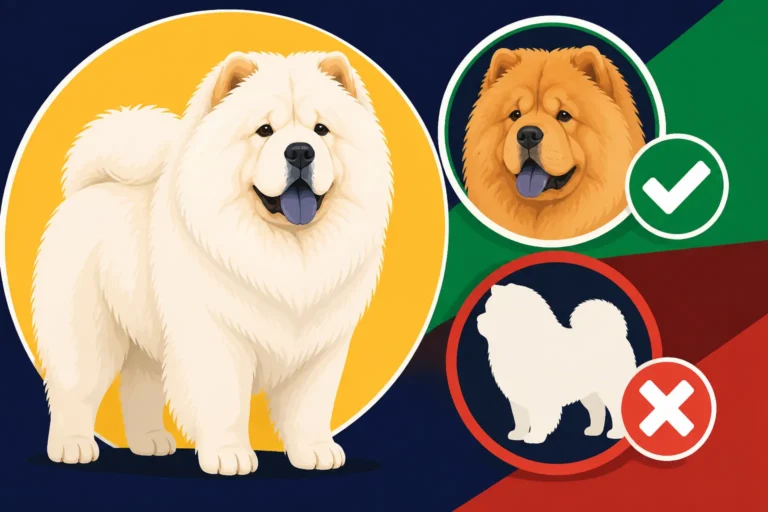
A Chow Chow is commonly recognized by its broad head, small upright ears, deep-set eyes, and a coat that may be rough or smooth. A rough-coated Chow Chow often has a prominent ruff around the neck and fuller hair on the legs and tail. The breed’s silhouette is distinctive, including its comparatively straight rear-leg structure and characteristic gait. The relevant breed-standard features are covered in What Gives a Chow Chow Its Broad Skull and Why a Chow Chow Walks Stiffly.
The Shar Pei is especially known for its loose, folded skin, small ears, and broad muzzle. The degree of wrinkling varies, and a puppy’s folds may look more pronounced than an adult’s. That wrinkled appearance is not a feature shared to the same extent by the Chow Chow. So while the breeds can look related at a glance, their overall outlines and defining features are different.
| Feature | Chow Chow | Shar Pei |
|---|---|---|
| Country of origin | China | China |
| Notable shared trait | Blue-black tongue | Blue-black tongue |
| Most recognizable physical features | Dense coat, broad head, small upright ears, straight rear-leg structure | Loose, folded skin, small ears, broad muzzle |
| Coat appearance | Rough or smooth coat varieties | Short, harsh coat is commonly associated with the breed |
| Relationship | Distinct breed with a long Chinese history | Distinct breed with a Chinese history; not established as a direct descendant of the Chow Chow |
Similar features do not mean identical needs
It is tempting to assume that dogs with shared origins or a few matching features will have the same temperament and care needs. That can lead to mismatched expectations. A dog’s behavior depends on more than its breed label: individual temperament, breeding, early experiences, training, health, and environment all play a part.
Chow Chows are often described as reserved and independent. Many are strongly attached to their family but do not seek attention from every visitor. They also have a dense coat that needs regular attention, including careful brushing to help prevent tangles and mats. Their deep-set eyes and facial structure can make routine observation and handling important parts of their care.
Shar Peis have their own behavior and health considerations, and a shared tongue color does not predict that they will behave like Chow Chows. If you are choosing between the breeds, meet adult dogs where possible, ask about the parents’ temperaments, and discuss breed-specific care with a veterinarian or a responsible breed expert. For a deeper discussion of Chow Chow temperament, see How Aloof a Chow Chow Really Is. For the coat-care side, Rough or Smooth: the Two Chow Chow Coats and What Each Needs explains why the Chow Chow’s grooming routine can be a significant commitment.
What Breed History Can and Cannot Tell You
The Shar Pei’s story is not a simple branch of the Chow Chow’s
The Shar Pei’s history is sometimes described in confident, tidy terms, but claims about the breed’s exact origins and early roles can be difficult to verify. Like many old regional dog types, it likely changed over time, and the modern breed reflects the dogs that survived, were selected, and were later developed through breeding programs.
That history makes a direct link to the Chow Chow especially hard to prove. A resemblance or shared regional heritage can suggest that the breeds have historical connections, but it does not show that one breed was deliberately crossed into the other or that one modern breed directly descended from the other. Without clear records, it is better to separate what is plausible from what is documented.
You may encounter claims that the blue-black tongue proves the Chow Chow and Shar Pei are close relatives, or that one breed was used to create the other. Treat those statements cautiously if they present a complicated history as a settled fact. The trait is a notable similarity; it is not proof of a specific breeding event.
Why accounts of ancient breeds can be confusing
People often use “ancient” to mean that a breed’s ancestors have existed in a region for a long time. That is not necessarily the same as saying today’s breed has remained unchanged for thousands of years. Dogs have been shaped by migration, interbreeding, changing work, human preference, and more formal breeding practices.
For example, an old image of a dog that resembles a Chow Chow may suggest that similar-looking dogs existed in China at that time. It cannot automatically confirm that the pictured animal had the exact ancestry, temperament, or breed identity of a modern Chow Chow. Historical art can be valuable, but it is not the same thing as a modern pedigree record.
Genetics can add another perspective, but it also has limits. A genetic test may provide information about a dog’s breed ancestry or broad genetic connections, depending on the test and the dog’s background. It cannot usually turn an uncertain historical story into a precise account of which ancient dog population gave rise to which modern breed. If you are curious about how breed identity is discussed in historical and genetic terms, What DNA Says About the Chow Chow's Age is a relevant next read.
How to Think About the Relationship as an Owner
Use the connection as context, not a care guide
If you own a Chow Chow or a Shar Pei, the breeds’ shared Chinese heritage is interesting background—not a substitute for learning about your individual dog. A Chow Chow should not be treated as a Shar Pei because both have a dark tongue, and a Shar Pei should not be assumed to share all of the Chow Chow’s coat, behavior, or health profile.
For prospective owners, practical questions matter more than a simplified family-tree claim. Consider the dog’s exercise needs, grooming, health risks, comfort with handling, and fit with your household. Meet the dog and ask specific questions about its parents and early socialization. If you are comparing the breeds, use breed-specific guidance rather than relying on one shared characteristic.
For Chow Chow owners, routine care includes watching for changes in the eyes, skin, gait, appetite, and energy. A thick coat can make it harder to spot some skin or body-condition changes, so regular hands-on checks are useful. A veterinarian can help you distinguish normal breed traits from symptoms that deserve attention.
A concise answer to the relationship question
Shar Peis and Chow Chows are distinct Chinese breeds that may share older regional ancestry. Their blue-black tongues are a memorable common feature, but that trait does not prove one breed descended directly from the other. Their documented histories, appearances, and care needs differ, and the exact historical relationship is not established as a simple direct line.
That is the most useful way to understand the connection: related in a broad historical sense, but not interchangeable and not proven to be direct ancestors of one another. When a source offers a more dramatic explanation, check whether it distinguishes evidence from speculation rather than treating a shared trait as proof.
Disclaimer
This article is for general informational purposes only and does not constitute professional advice. Laws, prices and regulations vary by location and change over time. Consult a qualified professional for guidance on your specific situation.