Whether the Chow Chow Is a Symbol in China Today
A Chow Chow’s lion-like mane, blue-black tongue, and long history in China make it easy to assume the breed is a national or cultural emblem there. The reality is more nuanced: the Chow Chow has genuine historical associations with China, but that does not make it an official symbol—or a familiar symbol to every person in the country today.
Is the Chow Chow a symbol of China today
A heritage breed is not automatically a national symbol
The Chow Chow is widely associated with China because the breed’s history is rooted there. Its distinctive appearance and reputation as an ancient breed can make it feel like a natural emblem of Chinese heritage. But “associated with China” and “a symbol of China today” are not the same thing.
A national symbol usually has a clear public role. It might be formally recognized, commonly used to represent a country, or strongly connected with shared civic identity. The Chow Chow does not have that kind of official status. It is not comparable to a national flag, a government emblem, or a widely recognized cultural icon.
That distinction matters when you see the dog described as a “Chinese symbol.” The phrase may be used loosely to point to the breed’s origin or distinctive look. It is not proof that people across modern China commonly treat the Chow Chow as a national mascot. For background on its origins, see Where the Chow Chow Comes From.
The breed can represent heritage without representing everyone
A person may look at a Chow Chow and think of Chinese history, traditional art, or an old breed. Another person may simply see a dog they like—or may have little familiarity with the breed at all. Those responses can coexist. Cultural meaning is rarely uniform across a large, diverse country.
The same is true of the Chow Chow’s image outside China. In North America or Europe, its unusual appearance may lead people to connect it with China before they know much about the breed’s history. That association can be sincere, but it can also reduce a complex living breed to a visual shorthand. A dog is not a complete representation of a culture just because its ancestry is associated with that place.
A careful answer, then, is that the Chow Chow can be a symbol of Chinese heritage for some people, particularly when its history is being discussed. It is not an official national symbol, and it should not be assumed to carry one shared meaning for all Chinese people.
What historical associations shape the Chow Chow’s image
Stories about ancient China can invite overstatement
The Chow Chow is often introduced as an ancient Chinese breed. That history contributes to its cultural associations, but popular retellings can make uncertain or complicated details sound settled. A story about an old-looking dog in artwork, for example, may be treated as direct proof that the modern breed existed in exactly the same form at that time. Historical resemblance and documented breed continuity are not identical claims.
It helps to separate broad context from specific evidence. The Chow Chow has a long association with China, but individual stories about its precise role, status, or presence in particular periods deserve careful treatment. Topics such as Whether the Chow Chow Is One of the Fourteen Ancient Breeds show why “ancient” can be a useful description while still leaving questions about how breeds and breed identities changed over time.
The Chinese names connected with the breed can also deepen that sense of history. What Songshi Quan Means explores one name often associated with the Chow Chow. Names and translations can offer clues about how people described a dog, but a name on its own does not establish that the breed held a single, fixed symbolic status.
Working roles are different from cultural emblems
The Chow Chow’s historical image is not only about appearance. Accounts of the breed have connected it with different practical roles, including guarding and hunting. Those roles help explain why people may see it as a dog with a substantial past, rather than simply a decorative companion.
But a working role does not automatically make a breed sacred, royal, or representative of a nation. A dog kept to guard a home or property may have been valuable to its owner without being a symbol recognized by a wider public. Claims about particular temple or noble associations should therefore be examined as historical claims, not treated as proof of a universal cultural meaning. For more on one recurring subject, see Whether Chow Chows Guarded Temples.
It is also worth resisting dramatic claims that turn every part of the breed’s history into a simple legend. Historical accounts can involve different regions, periods, and practices. Whether the Chow Chow Was a Nobleman's Dog Only and Whether Chow Chows Still Work in China offer useful ways to explore those questions without assuming the breed had one role everywhere or that its historical identity has remained unchanged.
| Question | Careful answer |
|---|---|
| Is the Chow Chow associated with China? | Yes. The breed has a longstanding connection with China. |
| Is it an official national symbol? | No. It does not have the status of an official national emblem. |
| Does everyone in China view it as a cultural icon? | No single view should be assumed across a large and varied population. |
| Can it represent heritage in a particular context? | Yes. People may use or understand it that way, especially when discussing breed history. |
| Do historical stories prove a single symbolic meaning? | No. A historical role or legend does not establish a shared modern meaning. |
How the Chow Chow is viewed in modern life
A living dog is more than a historical image
The Chow Chow is a real companion animal with everyday needs, not just a figure in a story about the past. People who live with one are likely to think about its temperament, health, grooming, and comfort before thinking about national symbolism. Its thick coat, independent nature, and distinctive face can shape how people experience the breed at home far more directly than its historical reputation does.
That everyday reality is easy to miss when an article or social post presents the breed mainly as an exotic emblem. A Chow Chow still needs patient handling, thoughtful socialization, regular grooming, and appropriate veterinary care. Its history may be a point of pride or interest, but it does not replace the work of caring for the individual dog.
The breed’s distinct look can also invite assumptions. Someone may expect a Chow Chow to behave like a character from a legend or to embody a particular cultural trait. Those expectations are not a reliable way to understand an individual dog. Breed tendencies are not a substitute for observing the dog in front of you, and cultural stories do not tell you whether a particular Chow Chow is comfortable with a stranger, a child, or another dog.
Media and commerce can make a symbol seem more universal
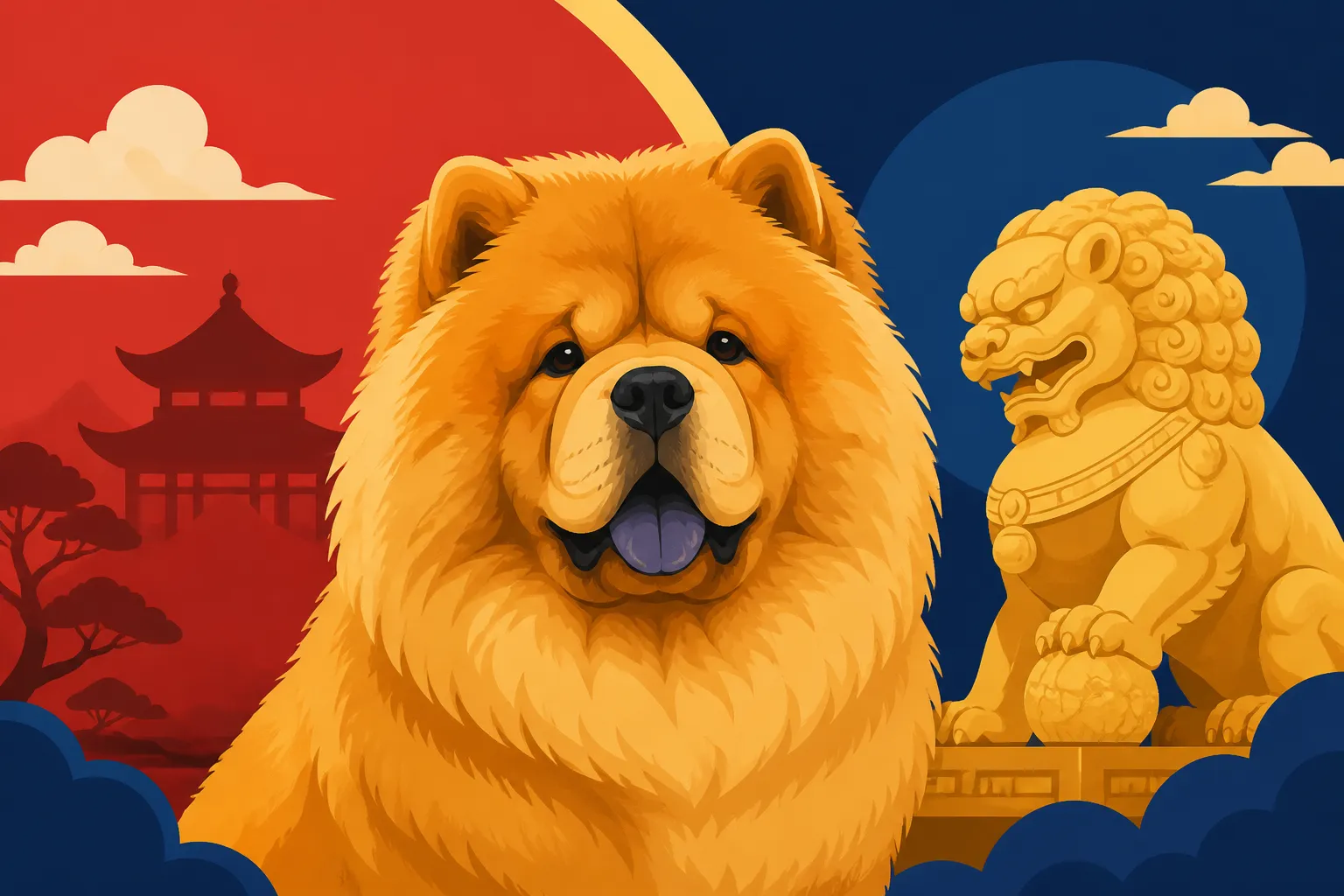
Images in advertising, films, social media, and pet products can reinforce the idea that a breed stands for a whole country. A stylized image of a Chow Chow beside a traditional motif may communicate a quick visual association. It does not necessarily show how widely that association is shared, or what the dog means to people who live in China.
The distinction is useful when browsing breed-themed merchandise. If an owner finds a Chow Chow design through a pet retailer such as Chewy, that item may reflect a customer’s affection for the breed or a seller’s marketing choice. It is not evidence that the dog has formal cultural status. Chewy and other retailers are part of the commercial world of pet ownership, where breed identity can show up on accessories, gifts, or everyday products.
Likewise, the presence or absence of a Chow Chow image in a particular store, campaign, or online feed cannot settle the cultural question. Chewy may help shoppers encounter pet-related products, but a retail listing is not a measure of national identity. When discussing modern symbolism, it is more accurate to describe what a specific image or person is communicating than to treat commercial visibility as proof of a shared belief.
How to talk about the Chow Chow’s cultural meaning respectfully
Use precise language instead of sweeping claims
If you are writing about the breed, phrases such as “a Chinese-origin breed” or “a breed with a long association with China” are more precise than saying “the dog symbolizes China.” The latter sounds definitive and can imply official recognition or widespread agreement where neither has been established.
It also helps to be clear about whose interpretation you mean. “Some people view the Chow Chow as a link to Chinese heritage” leaves room for different experiences. “Chinese people view the Chow Chow as a national symbol” makes a sweeping claim about a diverse population and should not be used without strong evidence.
The same care applies to traditional stories. If you are discussing a legend, call it a legend. If you are describing a historical association, explain what the claim concerns and avoid stretching it into a statement about all of Chinese culture. The breed’s blue-black tongue, for example, has generated many stories; Which Legends Explain the Chow Chow's Tongue is a reminder that memorable folklore and established historical fact are not interchangeable.
Keep cultural curiosity connected to responsible dog ownership
It is perfectly reasonable to be interested in the Chow Chow’s roots, appearance, and historical reputation. That curiosity is strongest when it leads to a fuller understanding of the breed rather than a single exotic label. Learning about the breed’s origins, roles, and changes over time can give its history more depth than a simple claim that it “represents China.”
If you are considering a Chow Chow, practical questions deserve equal attention. Ask about health testing, temperament, early socialization, and how the breeder prepares puppies for handling and everyday life. If you already share your home with one, focus on that dog’s comfort and behavior rather than expecting it to perform a symbolic role.
That balanced view keeps both parts in sight: the Chow Chow has a meaningful historical association with China, and it is also an individual dog living in the present. The breed can evoke heritage without standing for every person, place, or tradition connected with China. Being precise about that difference makes the conversation more respectful—and gives the Chow Chow’s history room to be interesting without turning it into a stereotype.
Disclaimer
This article is for general informational purposes only and does not constitute professional advice. Laws, prices and regulations vary by location and change over time. Consult a qualified professional for guidance on your specific situation.