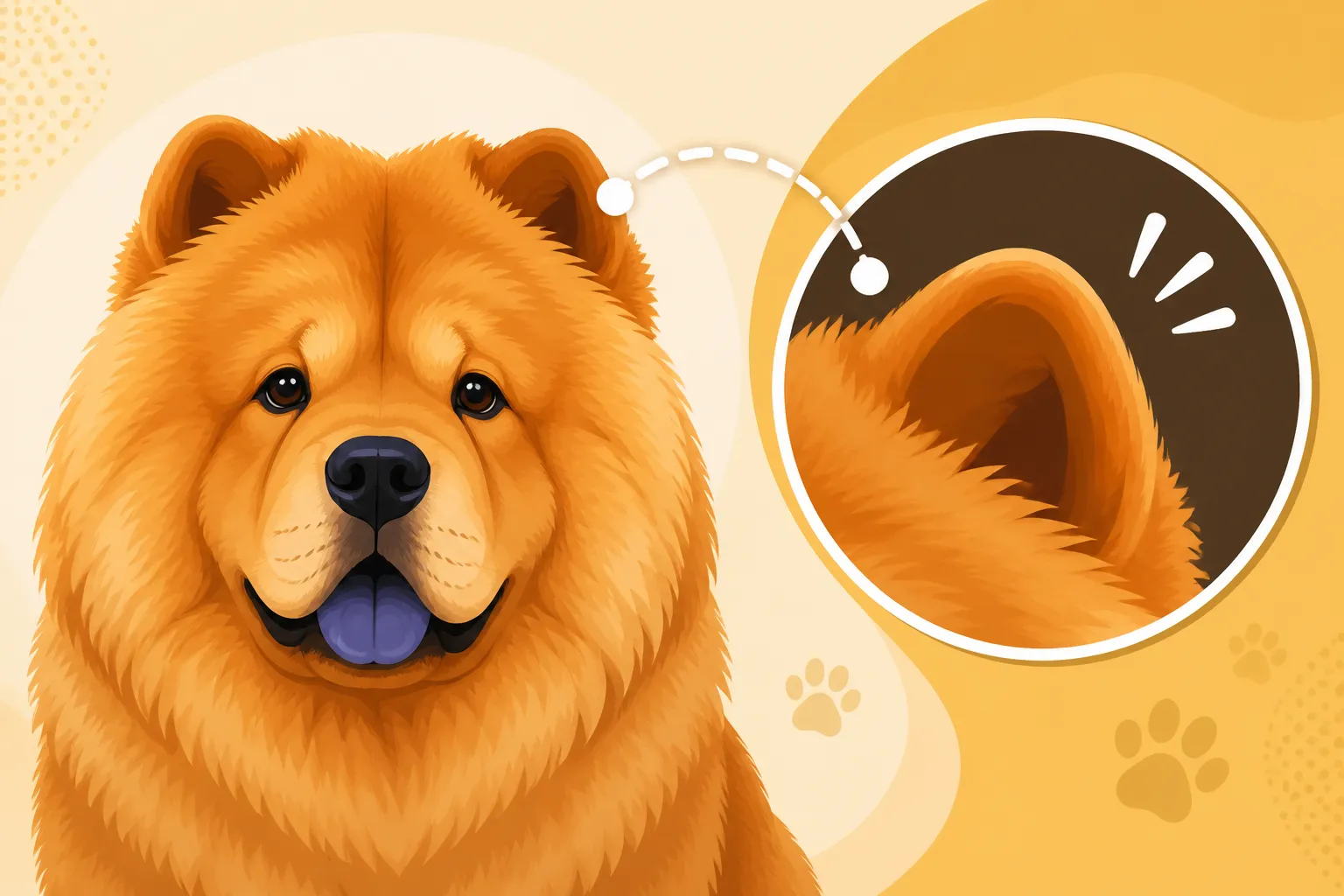
Why a Chow Chow’s Ears Are Small and Rounded
A Chow Chow’s ears are small, thick, and rounded at the tips, but their size is only part of the look. Their upright position and forward tilt help create the breed’s familiar alert expression. If you are wondering whether your dog’s ears look normal, why a puppy’s ears are still floppy, or how to care for them, this guide explains what to notice and when to ask a veterinarian.
What Chow Chow Ears Look Like
Small, thick, and rounded at the tips
Chow Chow ears are typically described as small, thick, and slightly rounded at the tips. They stand upright rather than folding over, and they sit well apart on the top of the head. The ears are not round like disks; they are more triangular in outline, with softened rather than sharply pointed tips.
That combination matters. A large, fine, sharply pointed ear would change the breed’s balanced head shape. Chow ears look compact against the broad skull, while their firm, erect carriage gives the head a tidy outline. For a closer look at how the head contributes to the breed’s silhouette, see What Gives a Chow Chow Its Broad Skull.
“Small” is relative, too. A Chow Chow puppy’s ears may look oversized or oddly placed as the head grows, while a heavily coated adult’s ears can seem partly hidden by fur. Coat, head shape, age, and the way the dog holds its ears all affect what you see. A difference in appearance alone does not necessarily mean there is a health problem.
Erect ears and the breed’s expression
The ears are carried upright and angled slightly forward. Along with the breed’s deep-set eyes and broad head, that position contributes to the serious, watchful expression many people recognize as a Chow Chow’s scowl. The expression is a result of the dog’s overall head shape and features, not proof that it is annoyed or unfriendly. You can read more about that expression in What the Standard Means by a Chow Chow's Scowl and Why a Chow Chow's Eyes Are Set So Deep.
A Chow’s ears can move, even if the dog’s face seems naturally stern. They may angle forward when the dog is paying attention, shift sideways in response to a sound, or settle into a more neutral position when the dog relaxes. Those small movements are useful clues, but they should be read alongside posture, distance, and the rest of the dog’s body language.
Because Chow Chows can be reserved with unfamiliar people, it is especially helpful not to judge their mood from their face alone. Give the dog space, avoid leaning over it, and let it choose whether to approach. For more guidance on interpreting the whole face rather than one feature, see How to Read a Chow Chow's Face.
What the ear shape does and does not tell you
It is tempting to assume that a breed feature must have a single, proven job. Small upright ears may look practical and compact, but appearance alone does not establish exactly why the trait developed or what advantage it offered in the breed’s past. It is safer to describe the shape as a characteristic part of the Chow Chow’s build than to claim a specific historical purpose without evidence.
The ears also do not indicate whether an individual Chow Chow can hear well. A dog with small ears may hear normally, while a dog with ears that look perfectly typical can still have a hearing issue. If your dog repeatedly fails to respond to familiar sounds, seems startled when approached, or reacts differently on one side, mention it to your veterinarian rather than relying on ear shape as a test.
| Feature | Typical appearance | What to keep in mind |
|---|---|---|
| Size | Small in proportion to the head | Fur and head growth can change how large they appear |
| Tip | Slightly rounded | The ears are not floppy or sharply pointed |
| Carriage | Upright | A puppy’s ears may not look fully erect at every stage |
| Position | Set apart on the top of the head | Placement contributes to the breed’s overall expression |
| Movement | Can angle or turn | Read ear position together with posture and behavior |
How Puppy Ears Develop
Why a Chow Chow puppy’s ears may look different
A young puppy’s ears can change in appearance as its head grows and the supporting cartilage develops. Some puppies’ ears stand more consistently as they mature; others may look uneven or temporarily less upright at certain stages. A puppy’s fluffy coat can also make the ear outline difficult to judge, especially in photographs.
This variation can worry new owners, particularly when one ear appears to stand before the other. A single snapshot is not always a reliable measure: the puppy may have turned its head, relaxed one ear, or been caught mid-movement. Look for the overall pattern over time instead of repeatedly comparing one side with the other in different poses.
If you have concerns, ask the breeder or your veterinarian to assess the puppy in person. They can distinguish ordinary variation from a concern that needs attention. Avoid trying to reshape the ears with tape, splints, supplements, or other home methods unless a veterinarian has specifically advised you to do so. Unnecessary handling can irritate the skin or make a puppy wary of having its head touched.
When a change deserves a closer look
A change in one ear is more concerning when it appears suddenly or comes with signs of discomfort. A puppy that begins holding an ear down, shakes its head repeatedly, scratches at the ear, or pulls away when you touch near it may have pain or irritation. Those signs are different from a puppy whose ears simply look uneven while it is growing.
There is no need to inspect the ears obsessively or force them upright to see how they look. Instead, watch for changes in comfort, behavior, and response to sound. If an ear becomes swollen, smells unpleasant, has unusual discharge, or seems painful, arrange a veterinary check rather than waiting for the shape to correct itself.
A puppy’s developing ears do not need special shaping care as part of normal ownership. What helps most is gentle handling and a calm introduction to routine checks. Briefly touch around the ear while offering praise or a small treat, then stop before the puppy becomes uncomfortable. This makes later grooming and veterinary examinations easier without turning ear care into a struggle.
Why not to compare every puppy with a perfect picture
Breed photos are often taken when a dog is alert, well groomed, and posed at an angle that shows the head clearly. Everyday life is less polished. A puppy may have damp fur, a relaxed ear, or a head position that makes one side look lower. These differences can make a normal young dog seem unlike a carefully chosen reference image.
Individual dogs also vary. A feature can be characteristic of a breed without looking identical in every dog. If you are choosing a puppy, focus on health, temperament, and responsible care rather than expecting every physical detail to match a photograph. For questions about other aspects of the breed’s head and appearance, How a Chow Chow Differs From an Akita offers another point of comparison.
Caring for Chow Chow Ears
Make gentle checks part of the routine
For most owners, ear care begins with looking rather than cleaning. Once in a while, gently lift or move the ear enough to see the outer ear and entrance to the canal. Look for redness, swelling, a strong odor, excess wax, discharge, or obvious sensitivity. Keep the check brief and calm, especially if your Chow is not used to having its head handled.
You do not need to put cotton swabs, fingers, or tools deep into the ear canal. That can irritate delicate tissue or push debris farther inside. If you think there is a buildup that needs cleaning, ask your veterinarian what product and method are appropriate for your dog. Advice can differ depending on whether the ear is healthy, irritated, or being treated for an infection.
Some Chow Chow owners keep soft cotton pads and a veterinarian-recommended ear cleanser with their grooming supplies. If you shop for supplies through Chewy, check that a cleanser is intended for dogs and follow your veterinarian’s advice about whether it is suitable for your pet. A product being easy to order does not mean it should be used in an ear that is painful, inflamed, or producing discharge.
Keep fur and cleaning simple
The hair around a Chow Chow’s ears can make it harder to see the skin, but trimming inside the ear canal is not a routine job for every dog. Do not pluck ear hair or cut close to the skin just because the ears look fluffy. If fur is blocking your view or regularly trapping debris, ask your groomer or veterinarian what is appropriate for your individual dog. See Whether a Chow Chow's Ear Hair Needs Trimming for more on that question.
After bathing or swimming, dry the outside of the ears gently if they are wet. Do not insert a towel or cotton pad into the canal. Moisture that remains inside can be uncomfortable, and dogs with recurring ear trouble may need a specific plan from their veterinarian. More general guidance on cleaning and monitoring is covered in How Often a Chow Chow's Ears Should Be Checked and Whether a Chow Chow's Ear Canal Is Narrow.
If your dog already has an ear-care routine recommended by a clinic, keep the supplies together so the process is predictable. Chewy can be one place owners look for basic grooming items, but the important part is choosing a suitable product and using it only as directed. If your dog resists, stop rather than wrestling through the task; discomfort or fear can make future checks harder.
Know when it is time to call the veterinarian
Contact a veterinarian if your Chow Chow has repeated head shaking, persistent scratching, redness, odor, swelling, discharge, or pain when the ear is touched. Tilting the head, loss of balance, or a sudden change in hearing or behavior also warrants prompt professional advice. These signs can have different causes, so guessing at a diagnosis or trying several cleaners may delay the right care.
A veterinary examination is particularly useful when symptoms return after cleaning or treatment. The clinician can inspect the ear canal and determine whether the problem involves infection, inflammation, parasites, a foreign object, or another cause. This matters because the right treatment depends on what is actually happening; a product that helps one problem may be unsuitable for another.
If you are preparing a first-aid or grooming kit, Chewy may carry general pet-care supplies, but an ear infection is not a shopping-list problem. Call your clinic for guidance, especially if the ear is painful or has discharge. Regular wellness visits also give you a chance to ask about subtle changes before they become a bigger concern; How Often a Chow Chow Needs a Wellness Exam explains what routine check-ins can help catch.
Separating Normal Appearance From a Health Concern
Shape is different from symptoms
A small, upright ear is a normal part of the Chow Chow’s appearance. An ear that looks slightly different from the other, or seems partly concealed by coat, is not automatically abnormal. What matters more is whether the dog is comfortable and whether the ear’s appearance has changed suddenly.
Compare your dog with its own usual appearance rather than with another Chow Chow. If an ear has always sat a little differently but the dog shows no discomfort, your veterinarian can assess it at the next routine visit. If the change is new, painful, or accompanied by odor, discharge, swelling, or frequent scratching, arrange an examination sooner.
Also remember that a dog’s outward expression can be misleading. A Chow Chow may look stern while relaxed, and a forward ear does not necessarily mean aggression or alarm. Give the dog time to communicate through its full posture and behavior. If you are unsure whether a change is physical or behavioral, describe what you have observed to your veterinarian.
A practical owner checklist
A simple routine can help you notice meaningful changes without turning every grooming session into an inspection. Pick a calm moment, such as after a walk or while your dog is settled at home. Look at the outer ear, check for odor or visible irritation, and stop if the dog pulls away or seems uncomfortable.
Keep notes if a symptom comes and goes. For example, write down when the head shaking started, whether it affects one or both ears, and whether you noticed a change after a bath or outdoor activity. Details like these can help a clinic understand the pattern. Avoid putting anything into the canal before an appointment unless the veterinarian has told you to do so.
Most importantly, treat the breed’s rounded ears as a normal feature, not a problem to fix. Their shape helps define the Chow Chow’s distinctive head, while ordinary observation and gentle handling are usually all an owner needs to do. When symptoms appear, rely on a veterinary examination rather than trying to diagnose the cause from ear shape alone.
Disclaimer
This article is for general informational purposes only and does not constitute professional advice. Laws, prices and regulations vary by location and change over time. Consult a qualified professional for guidance on your specific situation.