Whether the Straight Rear Leg Costs the Chow Chow Speed
A Chow Chow’s straight rear legs can make its movement look stiff and its sprint less explosive than a more heavily angulated dog’s, but that does not automatically mean the dog is slow, weak, or in pain. This guide explains how the breed’s hind-leg structure affects stride, what speed to expect, and how to tell normal movement from a problem that deserves veterinary attention.
What the Chow Chow’s straight rear legs mean
How the hind-leg structure affects movement
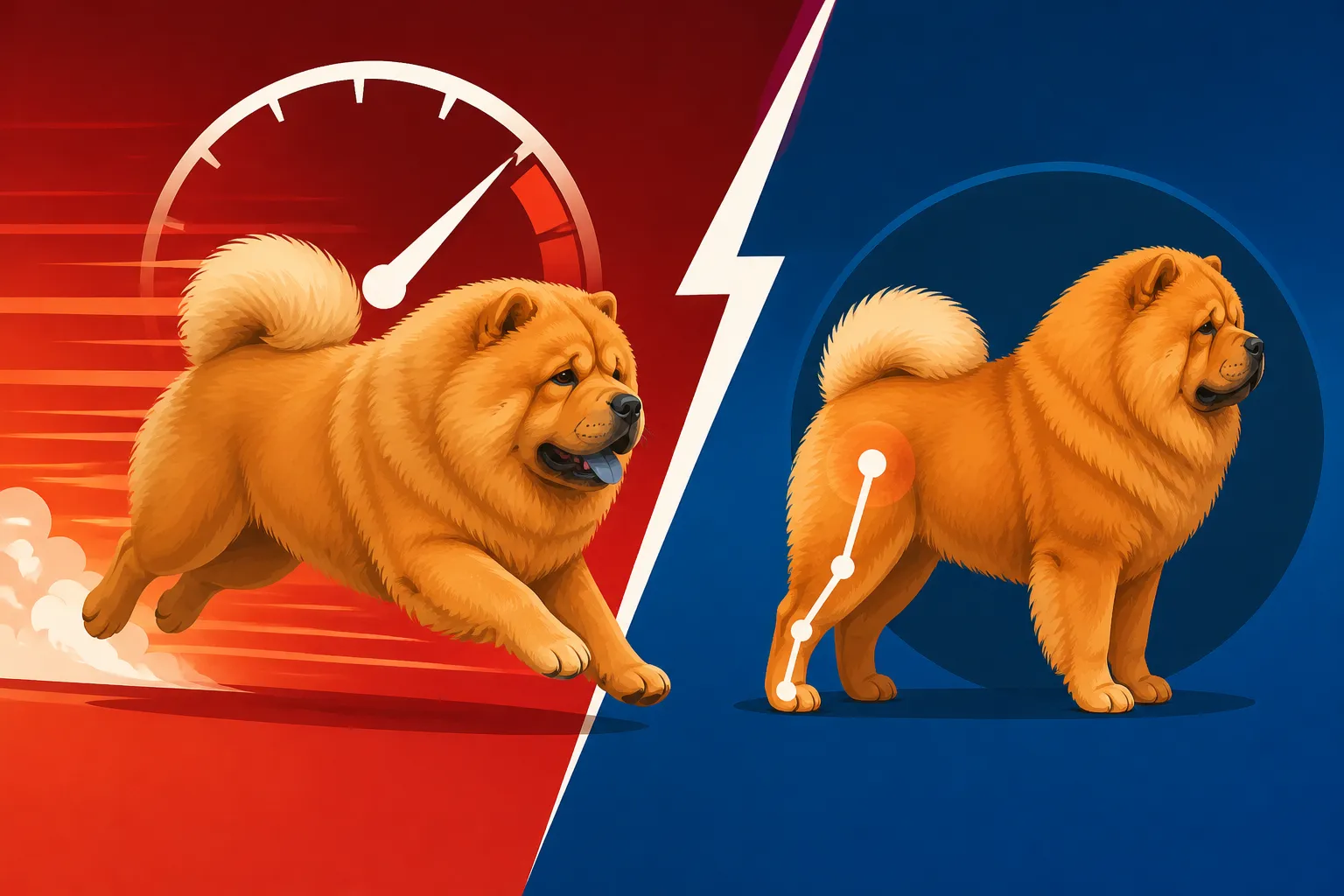
A dog’s rear legs help generate forward drive. In a Chow Chow, the hindquarter is comparatively straight through the stifle, or knee, and the breed’s distinctive structure tends to produce a shorter, more upright-looking stride than you might see in a dog built for sprinting. The hock—the joint above the rear foot—also plays a part in how the leg flexes and pushes off.
That difference is part of the breed’s shape, not proof that every Chow Chow has a defect. The breed is known for a characteristic gait that can appear stiff or stilted, especially beside dogs with longer, more reaching strides. The Straight Rear Leg No Other Breed Has explores the structure itself, while Why a Chow Chow Walks Stiffly looks at the movement people often notice.
A Chow Chow’s coat can make this look even more pronounced. Thick feathering around the thighs and hocks may obscure where the leg bends, and the dog’s compact outline can make a normal stride seem unusually rigid. Watch the feet and joints as the dog walks rather than judging only by its silhouette.
Does straightness automatically mean less speed
Not in a simple, one-to-one way. A straight rear leg may offer less visible flexion and reach than the hindquarter of a dog bred for fast running, but speed also depends on fitness, body condition, age, health, motivation, footing, and individual build. Two Chow Chows can have similar outlines and quite different athletic ability.
It helps to separate short bursts of speed from sustained pace. A healthy Chow Chow may trot briskly, play in short spurts, and move comfortably around the home without being suited to long-distance running or repeated high-speed fetch. The breed’s body is not designed to perform like a racing dog’s, and there is no need to push a dog into that role to prove it is healthy.
A dog that chooses a measured pace may simply be behaving normally. But a sudden change—such as reluctance to rise, a new limp, or stopping during a familiar walk—should not be explained away as “just the breed.” Why a Chow Chow's Gait Wears Its Joints discusses why movement patterns and joint comfort matter over time.
What a typical Chow Chow gait looks like
At a relaxed walk, a Chow Chow may appear compact and deliberate, with less sweeping reach through the rear than some breeds. At a trot, the movement can look brisk but controlled rather than springy. Breed-typical movement should still be coordinated: the dog should place its feet consistently, carry its weight comfortably, and move without obvious pain or loss of balance.
A normal-looking gait is not necessarily perfectly symmetrical in every moment. Dogs may shift position on uneven ground, turn their bodies to look, or briefly shorten a step after getting up. The key is the overall pattern and whether it changes. If you are unsure, take a short video of your dog walking toward and away from you on a level surface and show it to your veterinarian.
| What you notice | Possible interpretation | What to do |
|---|---|---|
| Short, deliberate stride that has been consistent over time | May reflect the breed’s structure and movement style | Monitor comfort and keep exercise moderate |
| Brief stiffness after resting that eases once moving | Could have several causes, including age-related stiffness | Mention it at a routine veterinary visit, especially if recurring |
| Limping, toe dragging, or uneven weight-bearing | Not explained by breed appearance alone | Arrange a veterinary assessment |
| Sudden reluctance to walk, rise, or use stairs | Possible pain or injury | Contact a veterinarian promptly |
| Panting heavily or slowing in warm weather | Heat stress may be contributing | Stop activity, move somewhere cool, and assess the dog |
How much speed and exercise to expect
A Chow Chow is not built like a running breed
It is more useful to think of the Chow Chow as a dog for steady, sensible activity than as a dog expected to run fast for long periods. Some individuals are playful and surprisingly quick for a short burst; others prefer a slower stroll and a good sniff. Neither temperament nor pace alone tells you whether the dog’s legs are healthy.
High-speed exercise can be harder to manage than a calm walk because rapid turns, abrupt stops, and repeated jumping place different demands on the joints. A game of fetch across a slippery lawn, for example, may involve sharp pivots that are more stressful than a controlled walk on a firm, even path. If your dog enjoys play, keep it brief, avoid forcing repeated sprints, and give it the choice to pause.
For general exercise planning, How Much Exercise a Chow Chow Actually Needs offers breed-specific context. The goal is regular, comfortable movement—not reaching a particular running speed or matching the pace of a more athletic dog.
Adjust walks for age, weather, and footing
A young dog’s exercise should be built gradually. Puppies are still growing, and long forced runs or repetitive jumping are not a useful way to test their speed. Choose manageable walks, relaxed play, and rest breaks, and ask your veterinarian how to adjust activity as your puppy develops. When a Chow Chow's Growth Plates Close explains why growth is relevant when planning strenuous activity.
For adult dogs, pay attention to the surface as much as the distance. Loose gravel, ice, steep slopes, and slick floors can make footing less secure. At home, a runner or nonslip mat can help a dog that hesitates on polished floors. If you are comparing practical household items, Chewy is one place owners may look for dog-safe floor runners or other mobility-related supplies, but fit and safety matter more than the retailer. Avoid anything that bunches up or creates a tripping edge.
Warm weather calls for extra caution. A dense coat and the breed’s physical characteristics can make heat management important, so choose cooler parts of the day, bring water, and stop if your dog begins slowing or struggling. Why the Chow Chow Is a Closed Angle Glaucoma Breed is unrelated to speed, but owners researching breed-specific health should also be aware that a painful or cloudy eye can affect confidence and movement. For heat-specific guidance, see Why a Chow Chow Overheats So Easily.
Build fitness without testing top speed
If your Chow Chow is comfortable and your veterinarian has no concerns, increase activity gradually rather than suddenly adding a long hike or intense play session. Start with familiar, easy routes. Add a little time or distance at a pace your dog can sustain, then check how it moves later that day and the following morning.
Mental activity can also help satisfy an energetic dog without requiring fast running. Scent games, food puzzles, and short training sessions let a dog work at a comfortable pace. If you shop for enrichment equipment, Chewy may be a convenient place to compare puzzle feeders, but choose a design that suits your dog’s size and chewing habits. Supervise new toys, particularly if your dog tends to tear items apart.
Stop the activity if your dog repeatedly lags behind, sits down, begins limping, or seems reluctant to continue. A dog should not have to be coaxed through obvious discomfort just to complete a planned route. On especially hot days, a shorter outing and indoor enrichment may be the better choice.
When a stiff or slow gait may signal a problem
Look for changes, not just breed traits
A naturally compact stride is different from a new or worsening movement problem. Notice whether the dog is slower than usual, shifting weight to one side, taking shorter steps with one leg, or struggling to rise after lying down. Also watch for changes in everyday behavior: avoiding stairs, refusing to jump into the car, or choosing to lie down during a walk can be clues that movement is uncomfortable.
The Chow Chow’s dense coat can hide changes in body shape and muscle condition. Run your hands gently over the hindquarters if your dog accepts handling, and pay attention to whether one thigh seems less developed or the dog reacts when a particular area is touched. Do not press hard or force an examination if the dog is uncomfortable.
A short video can be useful because dogs may move differently in a clinic than at home. Film the dog walking on a flat surface from the side and from behind, without making it run. Keep the clip steady and avoid calling or luring the dog into an unnatural pace. Bring it to your appointment along with notes about when the change began and what seems to make it better or worse.
Joint and kneecap conditions can affect movement
Straight rear-leg appearance does not diagnose a joint condition. Hip or elbow problems, knee injuries, soft-tissue pain, and other health issues can all change how a dog walks. A veterinarian needs to assess the dog’s history, gait, comfort, and physical examination findings before identifying a cause. Hip Dysplasia in a Chow Chow and Patellar Luxation in a Chow Chow cover two conditions that may be relevant when a dog has trouble moving normally.
Some dogs show discomfort as an obvious limp. Others simply move less, hesitate before getting up, or become irritable when asked to do something that hurts. A Chow Chow that is usually reserved may not make dramatic vocal complaints, so subtle behavior changes are worth taking seriously.
Seek prompt veterinary advice if limping starts suddenly, the dog cannot bear weight, there is marked swelling, or the dog seems distressed. Do not give human pain medication unless a veterinarian specifically instructs you to do so; some common medicines can be dangerous for dogs. If the gait change is gradual rather than sudden, arrange an appointment and describe the pattern clearly.
How to make a useful veterinary visit
Before the appointment, write down when you first noticed the change, whether it happens after rest or exercise, and whether it affects one or both rear legs. Note any recent slips, falls, unusually strenuous play, or changes in routine. A video is often more informative than trying to recreate the movement in a small examination room.
Ask what kinds of activity are appropriate while the cause is being assessed. Depending on the findings, the veterinarian may recommend rest, a structured return to activity, diagnostic imaging, rehabilitation, or another plan. Follow the advice rather than assuming that a breed-typical gait means no treatment is needed—or that every stiff-looking step requires the same intervention.
If your dog needs help getting around at home, focus on simple changes first: clear clutter, provide secure footing, and place food and water where the dog can reach them comfortably. Chewy may be one source for comparing nonslip mats or supportive walking equipment, but a harness or mobility aid should fit correctly and should not replace medical assessment. For owners whose dog resists handling during exams, Why a Chow Chow Is Hard to Examine at the Vet offers useful context on preparing for veterinary care.
Helping your Chow Chow move comfortably
Keep activity regular and low pressure
A comfortable routine is usually more useful than occasional intense exercise. Walk at a pace that lets your dog move easily, allow sniffing breaks, and avoid using another dog’s speed as the standard. If your Chow Chow stays relaxed and recovers normally after a walk, that is more meaningful than whether it can sprint.
Use gradual conditioning. After a quiet period, begin with shorter outings and build back carefully. If your dog is older, has a history of joint trouble, or is carrying extra weight, ask your veterinarian to tailor the plan. The Age a Chow Chow Gets Arthritis may also help owners understand why pace and comfort can change over time.
Maintain a healthy body condition
Extra body weight can increase the work required of the joints and make a dog appear slower. Because the coat can make a Chow Chow’s outline hard to read, assess body condition by feel as well as appearance. You should be able to feel the ribs without pressing firmly, while the waist and abdominal tuck remain visible when viewed from above and from the side.
If you are unsure about your dog’s weight, ask your veterinarian to assess body condition and recommend a suitable feeding and exercise plan. Avoid abrupt dieting or adding supplements simply because a dog seems stiff. The right approach depends on the dog’s health, age, food, and activity level.
Judge comfort, not a stopwatch
The straight rear leg can influence how a Chow Chow moves, but it does not set a universal speed limit. Many healthy Chow Chows are capable of comfortable daily walks and short periods of play, even if their stride looks less extended than that of a running breed. A breed-typical gait should still be coordinated and comfortable.
The most helpful question is not “How fast should my Chow Chow run?” but “Is my dog moving comfortably for its usual routine?” A steady, lifelong gait may simply be part of its build. A new limp, reluctance, or growing stiffness deserves attention, regardless of how the dog is supposed to look.
Disclaimer
This article is for general informational purposes only and does not constitute professional advice. Laws, prices and regulations vary by location and change over time. Consult a qualified professional for guidance on your specific situation.