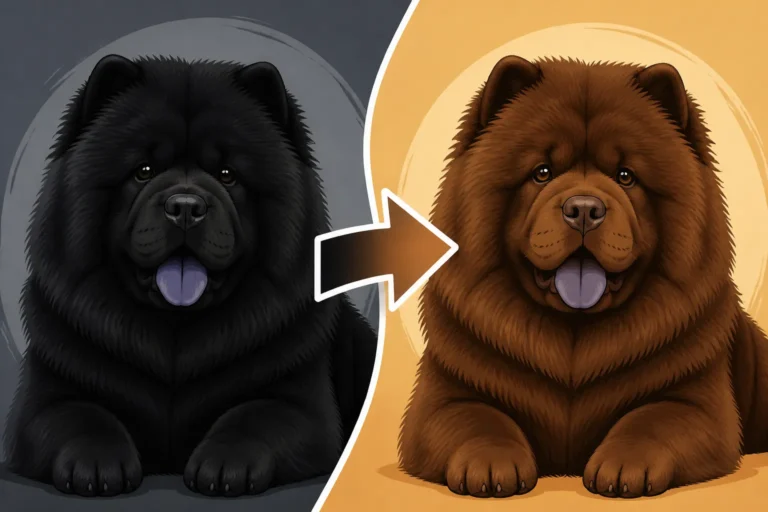
Whether a Merle Chow Chow Is Real
A merle Chow Chow can appear in online ads and social media photos, but merle is not one of the breed’s accepted colors. A dog described that way may be a Chow Chow mix, mislabeled, or photographed under misleading lighting. This guide explains what merle means, how it differs from standard Chow Chow coloring, and what to check before trusting a seller’s claims.
Is a merle Chow Chow a real breed color
Merle is a coat pattern, not a standard Chow Chow color
Merle describes an uneven pattern of lighter and darker patches in a dog’s coat. It can create a mottled, marbled, or dappled appearance, sometimes alongside pale eyes or areas of reduced pigment. It is not simply another word for blue, gray, or an unusual shade.
The accepted Chow Chow colors are red, black, blue, cinnamon, and cream. Those colors can vary in shade, and a dog’s coat may have lighter or darker areas, but ordinary shading is not the same as distinct merle patches. For a closer look at the recognized palette, see Which Five Colors the Chow Chow Standard Accepts.
Blue Chow Chows are sometimes mistaken for merle because their coats can look gray or slate-colored. A blue Chow Chow has a solid recognized color, though individual hairs or areas may appear lighter or darker. A visibly patchy pattern is a different matter. What a Blue Chow Chow Looks Like explains how blue differs from other accepted colors.
What a seller might mean by “merle Chow Chow”
A dog advertised as a “merle Chow Chow” may have Chow Chow ancestry, but the label alone does not prove that it is a purebred Chow Chow or that merle is an established color in the breed. The dog may be a Chow Chow crossed with a merle-patterned breed, a mixed-breed dog with a Chow-like appearance, or a dog whose coat is being described inaccurately.
Sometimes the word is used loosely for a coat that looks unusual in a photo. Lighting, shadows, a wet or dirty coat, and editing can all make color look patchier than it is. Puppy coats also change as dogs mature, although a change in shade does not make merle a standard Chow Chow color. Whether a Chow Chow's Color Changes as It Grows covers the normal shifts owners may see.
There is a useful distinction here: a dog can be real, lovable, and Chow-like without being a purebred Chow Chow of an accepted color. The concern is not that a dog with an unusual coat is automatically unhealthy or undesirable. It is that a buyer should receive accurate information about the dog’s ancestry, health, and expected adult appearance rather than paying for a claim that cannot be substantiated.
Why photos and color names are not proof
Online pictures are a poor way to verify a dog’s breed or genetic pattern. A seller may photograph a puppy in bright sunlight, use filters, or choose a close-up that hides its body shape and coat texture. Even an honest seller can mistake ordinary color variation for a rare pattern.
Ask for clear, unedited photos of the puppy and its parents in natural light, including full-body views. Then ask for the parents’ registered names and pedigree information, and confirm claims with the relevant registry rather than relying on a sales caption. A pedigree can help establish ancestry, but it does not by itself prove a particular coat pattern; genetic testing may be needed for that.
If the seller cannot explain what they mean by “merle,” or changes the story when you ask for documentation, pause. A dramatic color label can be used to make a puppy sound rare or valuable. That is a reason to ask more questions, not a reason to rush.
How to tell a merle claim from ordinary Chow Chow coloring
Look for a distinct, uneven pattern
Merle usually involves irregular patches that contrast with the surrounding coat. A solid blue Chow Chow, by comparison, should not be called merle simply because the coat looks gray, smoky, or slightly varied in certain light. Red, cinnamon, cream, and black coats can also have natural shading that changes the way they look across the body.
Do not try to identify a dog’s genetics from one phone photo. Look at several images taken in consistent daylight, and ask whether the pattern appears across different parts of the body or only in a shadowed area. If the coat is long and dense, as it often is in a rough-coated Chow Chow, the undercoat and the direction of the fur can also affect how color appears.
A breeder who understands the claim should be able to describe the dog’s documented ancestry and explain the basis for calling the coat merle. “It looks merle” is not documentation. If the seller has no records or genetic information, treat the label as unverified.
Check whether the dog is being presented as purebred
A Chow-like face, a broad head, or a dense coat does not establish purebred status. Mixed-breed dogs may inherit some recognizable Chow Chow traits while differing in size, coat, temperament, or health risks. For more on appearance and ancestry, see How to Tell a Chow Chow Mix From a Purebred.
Ask for the litter’s registration details and the parents’ records. Check that names and registration information are consistent, and ask what the breeder means by “purebred.” If the explanation relies only on appearance, that is not enough to establish lineage. A DNA ancestry test may offer clues, but results should be understood as estimates and interpreted alongside pedigree records.
Also ask about the adult dogs’ temperament and health. A seller focused almost entirely on a rare-sounding color may be diverting attention from more important questions: how the puppies are raised, what health evaluations have been done, and whether the breeder will take a dog back if the owner can no longer care for it.
Use a simple evidence checklist
| What you are checking | Helpful evidence | What should make you cautious |
|---|---|---|
| Coat pattern | Clear photos in natural light and a consistent description | One heavily edited image or a vague “rare color” claim |
| Purebred status | Verifiable pedigree and registration details | Appearance alone presented as proof |
| Merle genetics | Relevant genetic test results explained by the seller | A claim based only on eye color or a photo |
| Puppy health | Veterinary records and transparent health history | Pressure to pay before records are available |
| Breeder practices | Opportunity to ask questions and learn about the parents | Evasive answers or urgency built around scarcity |
A seller does not need to use technical language perfectly, but should be willing to show records and explain what is known and what is not. If the information is incomplete, the honest answer is that the coat or ancestry has not been verified.
Merle genetics and health questions to ask
Why merle genetics deserve careful discussion
Merle is associated with a genetic change that affects pigment distribution. In dogs where the pattern is present, breeding two merle-patterned dogs together can increase the chance of puppies inheriting two copies of the merle-associated variant. These puppies are sometimes called double merles.
Double-merle dogs have a higher risk of certain hearing and eye problems, including deafness and vision abnormalities. That does not mean every dog with a merle coat is unhealthy, nor does appearance alone tell you a dog’s exact genetic status. It does mean breeders should understand the genetics and avoid risky pairings rather than treating a striking pattern as a marketing feature.
For a purported merle Chow Chow, ask whether a qualified professional has reviewed the test results and the breeding plan. If a seller cannot say how the pattern was confirmed, do not assume that the term is accurate. If the dog is a cross, ask about the other breed’s contribution and health history too. Mixed ancestry does not automatically mean poor health, but it changes what information is relevant.
Ask about health, not just color
Request veterinary records for the puppy, information about the parents, and a clear account of any known hearing or vision concerns in the litter. Ask whether the puppy has had a veterinary examination and whether the breeder has observed any difficulty responding to sounds or navigating unfamiliar spaces. A buyer should not be expected to diagnose a puppy from a video.
For a Chow Chow or Chow mix, also ask about the health concerns relevant to the dog’s lineage and the parents’ screening. Merle claims should not distract from routine breed-health questions or from a careful assessment of how the puppies are being raised. A responsible breeder can explain the limits of what testing establishes and will not promise that a puppy is guaranteed to be free of every future condition.
If you already have a dog sold as a merle Chow Chow, your veterinarian can help decide whether a hearing, eye, or genetic assessment makes sense. Keep the paperwork and avoid breeding the dog based on appearance or a seller’s verbal assurance. A professional can help interpret the results and advise on any follow-up.
What to do if you are considering or already own one
Before buying, slow the conversation down
Ask the breeder to put key claims in writing: whether the puppy is being sold as purebred or mixed, what “merle” means in this case, which records support the claim, and what health information is available. Request time to review the material before placing a deposit. A trustworthy seller should be comfortable with reasonable questions.
Do not treat a higher price or a “rare” label as proof of quality. The coat may be unusual, but price does not establish pedigree, genetic health, or responsible breeding. Compare the breeder’s answers with the documentation, and walk away if the story remains unclear or you are pressured to act immediately.
If you are researching general care while evaluating a dog, resources from retailers such as Chewy may help with everyday pet-care questions, but a store page or customer review cannot verify breed or coat genetics. Chewy can be a place to look for ordinary supplies once you know what your dog needs; for ancestry and health claims, rely on records, a veterinarian, and appropriate testing.
If you already have a dog described as merle
You do not need to panic or assume your dog has a health problem because someone used the word “merle.” Start by collecting the adoption or breeder paperwork, asking for any available parent and litter records, and discussing the dog’s coat and health history with your veterinarian. If the dog is thriving, that is reassuring, but it does not replace an examination when one is warranted.
A Chow Chow mix can be a wonderful companion regardless of whether the original label was accurate. Your practical priorities are the dog’s well-being, safe handling, preventive care, and a clear understanding of any known risks. Chewy’s general pet-care information may help with routine questions about supplies and day-to-day needs, while your veterinary team is the right place to discuss testing, hearing concerns, eye changes, or other symptoms.
When describing your dog to others, it is fine to say that the dog was advertised or adopted as a “merle Chow Chow” if that is the history you were given. If the ancestry and genetics have not been verified, avoid presenting the label as a confirmed breed color. That small distinction keeps the description honest without diminishing the bond you have with your dog. Chewy may be useful for routine shopping, but no retailer can substitute for clear pedigree records or a professional interpretation of genetic results.
Keep the bigger picture in view
“Merle Chow Chow” is not an accepted standard color description for the breed. A dog advertised that way may be a mix, may have been mislabeled, or may simply look unusual in a photograph. The sensible response is to verify the claim, ask about health and ancestry, and focus on whether the breeder is transparent and the dog’s needs are being met.
If the dog is already part of your family, the label matters less than reliable care. Get the records you can, share any concerns with your veterinarian, and make decisions based on your individual dog rather than an online claim about rarity.
Disclaimer
This article is for general informational purposes only and does not constitute professional advice. Laws, prices and regulations vary by location and change over time. Consult a qualified professional for guidance on your specific situation.