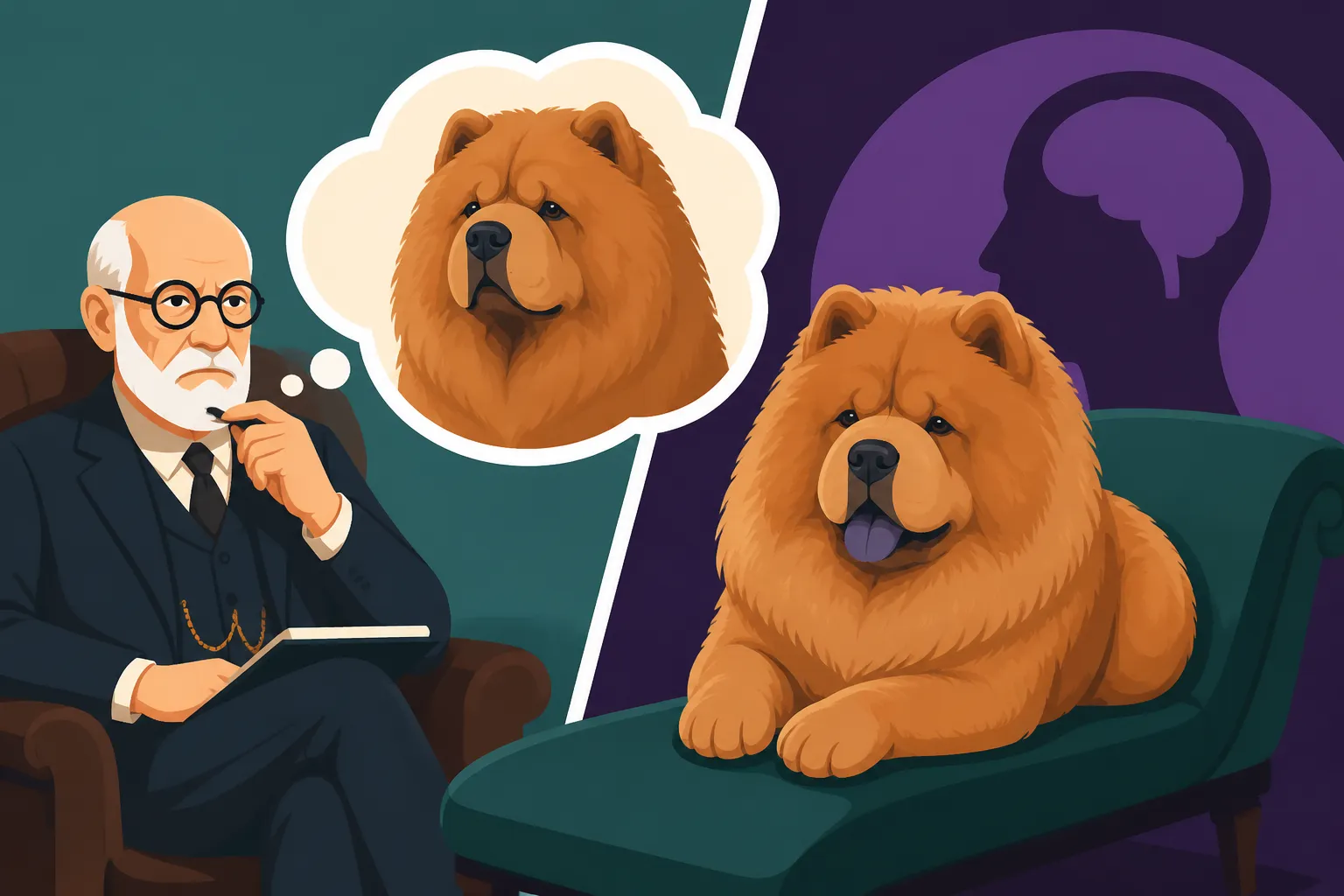
Whether Freud Used His Chow Chow to Read Patients
Freud’s Chow Chow Jofi became part of the story of his consulting room, which has led to a tempting question: did he use the dog to judge his patients? The careful answer is that Jofi was present and may have helped Freud notice how people responded to her, but she was not a diagnostic tool. Here’s what the story can—and cannot—tell us.
Did Freud use Jofi to read his patients?
Jofi was present, but presence is not diagnosis
Sigmund Freud kept a Chow Chow named Jofi, and accounts of his later working life describe her spending time in or around his consulting room. That detail is the solid starting point. A dog in a therapy room can change its atmosphere: some people relax, others feel self-conscious, and a few may be uneasy around dogs. Freud could observe those reactions as part of the human encounter.
But that is different from using Jofi to diagnose someone. There is no good reason to treat a dog’s posture, approach, or willingness to sit near a person as a reliable measure of that person’s character, honesty, or mental health. A dog reacts to many things at once, including movement, sound, familiarity, scent, and its own mood. The same behavior can have several explanations.
So the most responsible answer is: Freud may have noticed how patients behaved around Jofi, and her presence may have informed the atmosphere of a session. That does not establish that he used her as a clinical test or relied on her reactions to interpret patients.
Why people remember the idea
The story sticks because it feels plausible. Dogs often notice changes in the room that people overlook: a sudden movement, a raised voice, or a person shifting uneasily in a chair. If a dog settles beside one visitor and keeps its distance from another, people naturally start asking what the dog “knows.”
That question can turn an ordinary observation into a much bigger claim. Jofi’s behavior may have helped a patient feel more at ease, or it may have given Freud a chance to see how someone responded to an animal. But a dog’s response is not a verdict. A Chow Chow that moves away from a patient might be tired, distracted, warm, or simply seeking a quieter spot.
The distinction matters because the popular version can suggest that Jofi uncovered hidden truths about people. It is more grounded to say that she was a companion in a setting where people were talking about difficult things. Her presence could influence the interaction without functioning as a lie detector or a substitute for clinical judgment.
What Jofi’s role can reasonably be called
A helpful description is “informal social presence,” not “diagnostic instrument.” Jofi may have made Freud’s office feel less formal for some patients. A dog lying quietly in the room can offer a neutral focus for a moment, especially when a person is nervous or unsure what to say. That benefit does not require the dog to interpret anyone.
It is also possible that Freud paid attention to how patients interacted with Jofi. A person might speak to her, avoid her, ask to pet her, or become distracted by her. Those behaviors could prompt conversation. Still, the useful information would come from discussing the patient’s own experience, not assigning a fixed psychological meaning to the dog’s response.
For a closer look at the historical question of whether Jofi was actually in the consulting room, see Whether Freud's Chow Chow Sat In on Sessions. And for the name most closely connected with Freud’s Chow Chow, see What Freud's Chow Chow Was Called.
What the Freud and Jofi story does not prove
A dog’s behavior has many possible causes
Dogs respond to their immediate surroundings, not to a neat category such as “good person” or “bad person.” A Chow Chow might keep its distance because a stranger leans over it, speaks loudly, or moves quickly. The dog could also be hot, uncomfortable, sleepy, or unfamiliar with the room. Even a friendly dog may choose not to approach someone.
This is especially important with a breed known for being reserved with unfamiliar people. A Chow Chow’s reluctance to engage should not be treated as evidence that a visitor is dangerous or untrustworthy. Likewise, a dog seeking someone’s attention does not prove that the person is unusually calm or emotionally healthy.
Freud’s story is often retold in a way that makes the dog seem like an expert observer. A more realistic interpretation is that Jofi was an individual dog, with her own preferences and limits, in a room full of people and changing circumstances. Any observations Freud made would have needed to be considered alongside the patient’s words and the broader context.
Anecdotes grow as they are retold
Stories about famous people and their animals tend to become cleaner and more dramatic over time. A modest account of a dog accompanying its owner can turn into a tale about the animal accurately judging everyone who entered the room. The more memorable version is not necessarily the more reliable one.
That does not mean the story is worthless. It gives us a glimpse of how an animal could be part of a professional’s daily life and how patients might respond to that presence. It simply means we should separate what the story supports from what later retellings may imply.
A careful reading keeps three ideas apart: Jofi was associated with Freud; she was reportedly present around his work; and claims about her reliably reading patients require stronger evidence than an appealing anecdote. The first two ideas can be discussed without turning the third into fact.
| Claim about Jofi | What can reasonably be said |
|---|---|
| Jofi was Freud’s Chow Chow | She is widely identified as his Chow Chow |
| She spent time around his consulting work | Accounts describe her presence in or near the consulting room |
| Freud noticed how patients reacted to her | This is plausible, but it should be framed as observation rather than a formal method |
| Jofi diagnosed patients or detected dishonesty | The story does not establish this |
| Her presence may have comforted some people | A dog can affect the mood of a room, though people respond differently |
The dog’s comfort mattered too
Looking back at Jofi as a character in a famous story can make it easy to focus only on what people thought she represented. A more humane view also asks whether the dog herself was comfortable. A consulting room contains unfamiliar visitors, close physical spaces, and emotional conversations. A dog needs the ability to rest, move away, and avoid unwanted contact.
That principle applies to any dog brought into a workplace or support setting today. The animal should not be expected to tolerate every person or every interaction simply because humans find the dog calming. A Chow Chow’s quietness, in particular, should not be mistaken for consent to be touched. Some dogs are content to lie nearby while preferring not to be petted.
Freud’s connection with Jofi can therefore lead to a useful modern question: how do we make a dog’s presence comfortable for both the people and the animal? That question is more practical than asking whether a dog can read someone’s mind.
How a Chow Chow’s temperament fits the story
Reserved does not mean uncanny
Chow Chows are often described as independent and reserved, especially with people they do not know. That temperament can make a dog seem unusually discerning. If a Chow Chow chooses to approach one person and not another, observers may assume the dog has made a deep judgment. In reality, the dog may simply be responding to familiarity, body language, or its own preference for space.
This is one reason the Jofi story can be misread. A dog that is not eagerly greeting every visitor may appear to be assessing the room. But reserve is not the same as insight. Some Chow Chows are affectionate with their families while remaining selective about strangers, and individual dogs vary widely. For more on how the breed may show closeness, see How a Chow Chow Shows Affection and How Affectionate a Chow Chow Is.
A dog’s boundaries also matter. Reaching over a Chow Chow’s head, leaning close, or trying to force a greeting can make an already cautious dog more uncomfortable. A calm dog may prefer to observe from a distance. Readers interested in safe introductions can also explore How to Approach a Chow Chow Safely.
Individual behavior is not a breed-wide rule
It would be a mistake to infer that every Chow Chow would behave like Jofi, or that the breed has a special ability to evaluate people. Breed tendencies describe broad patterns, not guarantees about an individual animal. A Chow Chow raised with patient socialization may be comfortable in a range of settings; another may prefer familiar people and predictable routines.
A dog’s behavior can also shift with age, health, experience, and environment. A dog that once tolerated visitors may become less comfortable when sore or tired. A person who knows the dog well may spot small changes, but even an experienced owner should be cautious about assigning a single meaning to them.
The more grounded lesson is that dogs communicate preferences through behavior. They may approach, turn away, seek distance, or settle in a particular place. Those signals are worth respecting, but they should not be transformed into a psychological reading of the humans nearby. For related discussion of the breed’s social style, see How a Chow Chow Greets Visitors and How a Chow Chow Treats the Rest of the Family.
What modern readers can take from Freud’s dog
Dogs can shape a room without interpreting it
A calm dog can make a room feel less sterile. For someone who is anxious, the quiet presence of an animal may offer a small point of comfort: a chance to pause, take a breath, or speak more naturally. Other people may dislike dogs, have allergies, or feel nervous around them. The same animal can be reassuring to one visitor and distracting to another.
That is why any modern use of dogs in therapeutic or professional settings needs clear boundaries and the option for people to decline contact. The dog should have a quiet place to retreat, access to water, and a handler who watches for signs of stress. Comfort should be offered, never imposed.
For an owner setting up a calm resting place at home, practical basics such as a washable bed, water bowl, and enrichment items can be found through retailers such as Chewy. The important part is choosing things that suit the individual dog and giving it space, rather than assuming every Chow Chow wants to be handled or included in every activity.
A better way to interpret a dog’s response
If a dog behaves differently around different people, start with the immediate details rather than a sweeping conclusion. Did the person approach quickly? Was the room noisy? Was the dog already tired? Did the dog have a familiar handler nearby? These questions help explain behavior without turning it into a mysterious judgment.
Then look at the dog’s whole body and the context. A dog that turns away, stiffens, hides, or repeatedly tries to leave may be asking for space. The right response is to reduce pressure and let the dog choose whether to re-engage. A dog lying nearby may be relaxed, but that still does not mean it wants to be touched.
If readers want to support a dog’s comfort during visits, Chewy is one place to look for everyday supplies such as a familiar mat or an appropriate chew, though the dog’s temperament and safety come first. For a Chow Chow, familiar routines and respectful handling are usually more useful than trying to make the dog perform a role as a greeter or emotional evaluator.
The most honest answer to the question
Did Freud use his Chow Chow to read patients? The evidence supports a nuanced answer: Jofi was part of the environment around Freud’s work, and he may have noticed how people responded to her. Her presence could have influenced the mood of a session and offered some patients comfort. But the story does not show that she was a formal diagnostic tool or that her reactions reliably revealed what patients were thinking.
That distinction lets us appreciate the human-animal connection without exaggerating what a dog can know. Jofi did not need to be a mind reader to matter. She could simply be a companion whose presence changed the room, while remaining a dog with her own needs, preferences, and limits.
For readers interested in the broader history of the breed, The Chow Chow Is One of the Oldest Breeds in the World offers context for the long relationship between people and Chow Chows. For practical everyday care, Chewy may help owners find routine supplies, but no product can replace learning an individual dog’s signals and respecting its boundaries.
Disclaimer
This article is for general informational purposes only and does not constitute professional advice. Laws, prices and regulations vary by location and change over time. Consult a qualified professional for guidance on your specific situation.