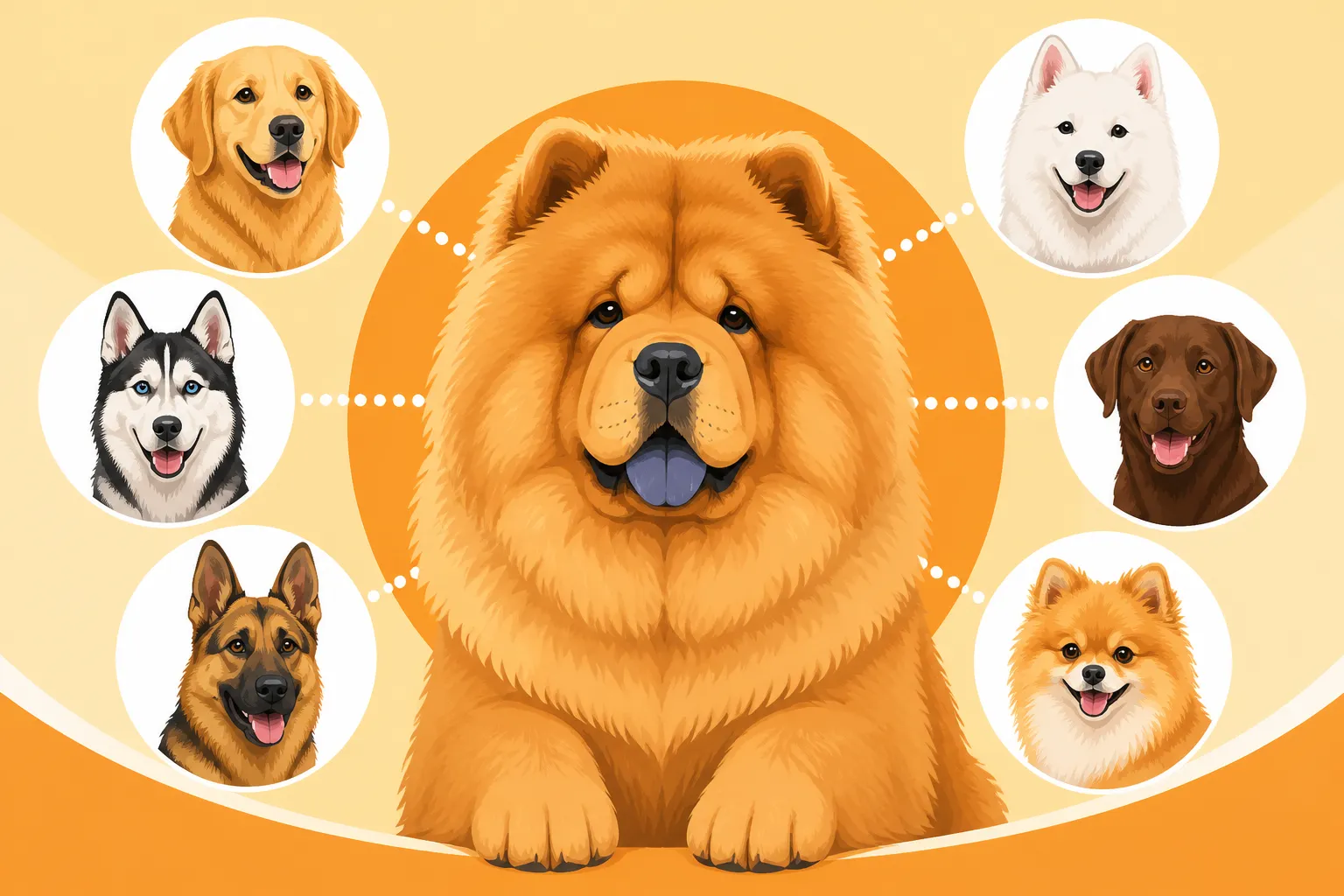
Which Crosses Chow Chows Appear In
A dog advertised as a “Chusky” or “Chow Shepherd” may look nothing like the photos you found online. Chow Chow mixes can inherit very different combinations of coat, build, and temperament, and informal mix names are used inconsistently. This guide explains the crosses you may encounter, what their labels can—and can’t—tell you, and how to assess an individual dog more reliably.
Common Chow Chow crosses and the names you may hear
There is no single official list of Chow Chow crossbreeds. Names such as “Chusky” are informal labels, not standardized breeds, so the same name can describe dogs with different backgrounds. A dog’s appearance, behavior, and care needs depend on the particular parents and the individual dog—not just the nickname.
| Informal cross name | Other breed commonly meant | What the label may suggest, but cannot guarantee |
|---|---|---|
| Chusky | Siberian Husky | A medium-to-large dog; coat, energy, and sociability can vary widely |
| Chow Shepherd | German Shepherd | A sturdy dog that may need thoughtful training and regular activity |
| Chow Pei | Shar-Pei | A compact-to-medium dog that may have facial folds or a dense coat |
| Chow Lab | Labrador Retriever | A range of sizes and coats, with different possible activity levels |
| Chow Akita | Akita | Often a substantial dog; careful introductions and handling matter |
| Chowpit | Pit bull-type dog | A broad label that may refer to several different pit bull-type breeds |
| Chowdoodle | Poodle | Coat texture and shedding can be unpredictable, especially in first-generation crosses |
Chusky and Chow Husky mixes
“Chusky” usually refers to a Chow Chow crossed with a Siberian Husky. These dogs may have a thick double coat, but coat color, length, and density can differ even among littermates. A blue or dark tongue, upright ears, or a curled tail may be inherited, but none of those traits is guaranteed by the label.
People sometimes expect a Chusky to be especially energetic because Huskies are known for stamina. That may be true for an individual dog, but there is no reliable way to predict a mix’s exercise needs from its nickname alone. Ask about the dog’s actual behavior: Does it settle indoors after a walk? Does it pull hard on leash? Does it try to escape from yards or doors? Those practical details matter more than the word “Chusky.”
A heavy coat also deserves realistic planning. A mixed dog may shed substantially and need regular brushing, especially if it inherits a dense undercoat. If you’re preparing for a dog with thick fur, Rough or Smooth: the Two Chow Chow Coats and What Each Needs offers useful background on the grooming demands associated with Chow coat types.
Chow Shepherd and Chow Lab mixes
A “Chow Shepherd” generally means a Chow Chow and German Shepherd mix. Depending on the dog, it may have a dense coat, a more athletic frame, or a mix of features from both parents. The name does not tell you whether the dog will be outgoing, reserved, highly trainable, or comfortable with strangers. Look at the individual’s responses and history rather than assuming a particular personality.
A “Chow Lab” usually means a Chow Chow crossed with a Labrador Retriever. Some dogs may have a shorter coat than a typical rough-coated Chow, while others retain plenty of fluff. The mix can also inherit very different activity levels. A family hoping for an easygoing companion should ask whether the dog can relax at home, cope with time alone, and walk calmly—not just whether it resembles a Lab.
For either cross, it helps to understand how Chow traits may show up without treating them as destiny. Whether a Chow Chow Mix Keeps the Temperament explores why a mix’s behavior cannot be predicted from appearance alone. Early, low-pressure introductions and reward-based training can help a dog learn household routines, while forcing greetings or relying on harsh corrections can make handling more difficult.
Chow Pei, Chow Akita, and Chowpit mixes
“Chow Pei” is commonly used for a Chow Chow and Shar-Pei mix. Some dogs may have visible facial folds, while others have a smoother face. Folds can hold moisture and need to be checked and kept clean if they are present. Don’t assume that a dog with a few wrinkles needs the same care as every other dog with a similar label; inspect the skin and ask a veterinarian about redness, odor, or persistent irritation.
A “Chow Akita” usually refers to a Chow Chow crossed with an Akita. This can describe a large, powerful dog, but the name cannot confirm adult size or temperament. Ask how the dog behaves around unfamiliar people and dogs, how it handles restraint, and whether it has a history of guarding food or space. When considering a dog with either parentage, introductions should be managed carefully and based on the animal in front of you.
“Chowpit” is a less precise label. “Pit bull” can refer to different breeds or types, so it may not identify the dog’s ancestry clearly. A shelter or previous owner may use it as a visual description rather than a confirmed pedigree. Keep that uncertainty in mind when discussing the dog’s history, size, or likely care needs.
Why Chow Chow mixes can look and behave so differently
A mix is not a predictable midpoint between two breeds. Puppies can inherit different combinations of traits from each parent, and siblings may look or act unlike one another. Even when a cross has a familiar nickname, the name cannot tell you exactly what the adult dog will be like.
Coat, size, and facial features vary
A Chow Chow parent may pass on a dense coat, a broad head, or a curled tail, but a mixed dog may inherit only some of those features. The other parent’s traits can also influence coat length, texture, body shape, and shedding. As a result, two dogs described by the same cross name may have very different grooming needs.
Puppy appearance can be especially misleading. A young dog’s coat may change as it grows, and its adult build may not be obvious from a photograph. If you are adopting, ask for the dog’s approximate age, weight history, and any information about its parents. Those details are more useful than relying on a label or trying to predict adult size by comparing the puppy to a breed chart.
Grooming needs can be more demanding than a short coat suggests if the dog has a thick undercoat or tangles easily. If you need a brush, comb, or other basic supplies, a retailer such as Chewy may be one place to look; choose tools based on the dog’s actual coat and ask a groomer or veterinarian for guidance if mats are forming close to the skin. Brushing should be comfortable, not a struggle that leaves the dog frightened or sore.
Temperament is individual, not a recipe
Some Chow Chow mixes are confident with familiar people but reserved around strangers. Others are social, bouncy, or eager to engage. A dog’s behavior can reflect its inherited tendencies, early experiences, health, training, and current environment. No cross name is a dependable guarantee of friendliness, guarding behavior, or ease of training.
When meeting a dog, give it room to approach rather than reaching over its head or crowding it. Notice whether it turns away, stiffens, freezes, or repeatedly tries to create distance. Those signals deserve respect. If children will live with or visit the dog, supervise interactions and teach children not to hug, corner, or disturb it while it is eating or resting.
A Chow-influenced dog may also have a limited field of vision if its eyes are set deeply or its facial structure blocks some sightlines. Approach from where the dog can see you, especially when it is resting. How a Chow Chow's Deep Set Eye Limits Its Vision explains why visual access can matter when reading a dog’s reactions. For more on safe handling, see How to Approach a Chow Chow Safely.
Activity, training, and social needs deserve individual assessment
Two dogs with the same mix label can have different exercise needs. One may enjoy longer walks and active games; another may prefer short outings and plenty of rest. Ask the rescue, breeder, or current caregiver how the dog behaves on leash, whether it can settle indoors, and what activities it enjoys.
Training should be clear, consistent, and rewarding. Short sessions can be more useful than repeating the same cue until the dog loses interest. For a Chow-influenced dog, cooperation and trust matter: give it time to understand the request, reward the behavior you want, and avoid forcing contact when it is worried. A qualified trainer who uses humane, reward-based methods can help with specific concerns such as leash reactivity or handling sensitivity.
If you’re choosing a puppy, ask how it has been introduced to everyday sounds, people, surfaces, and gentle handling. Socialization does not mean making a puppy greet everyone. It means creating safe, positive experiences at a pace it can manage. Why Early Socialization Decides What a Chow Chow Becomes provides more context about building comfort without overwhelming a young dog.
How to identify a Chow Chow mix more reliably
A visual guess can be a starting point, but it is not proof of parentage. Dense fur, a broad face, or a curled tail can appear in different combinations, and mixed-breed dogs do not always match familiar breed photographs.
Ask about the dog’s history before relying on a label
If you are adopting from a rescue or shelter, ask what is known about the dog’s parents, previous homes, and behavior. Find out whether the label came from a former owner, a visual estimate, or a genetic test. Each source has different limits. A shelter may use a likely mix description to make a listing easier to understand, not to claim that ancestry is confirmed.
Ask practical questions as well: Has the dog lived with children or other pets? How does it respond when someone approaches its food? Can it be brushed and examined? Has it shown discomfort around strangers or on leash? A frank account of strengths and challenges is more valuable than a confident-sounding mix name.
If the dog’s past is unknown, treat that as uncertainty—not as a reason to assume the worst or the best. Give the dog time to settle, use careful introductions, and observe its behavior in different situations. A dog that seems quiet in a shelter may act differently once it feels safe in a home.
Understand what a DNA test can and cannot answer
A canine DNA test may offer clues about ancestry, but results are not the same as a pedigree or a complete health assessment. Test findings can vary by the reference information used, and a percentage estimate should not be treated as a precise explanation for every feature or behavior.
A genetic result also cannot tell you exactly how a dog will behave, how much it will shed, or what its adult appearance will be. Use it as one piece of information alongside veterinary records, the dog’s observed behavior, and a conversation with the people who know it. If you have a health concern, ask a veterinarian about the dog’s symptoms and appropriate examinations rather than relying on ancestry estimates.
When a mixed dog’s family history is unknown, routine veterinary care still matters. Tell the clinic what is known about the dog’s background and ask for recommendations based on its age, condition, and lifestyle. If the dog is hard to handle, discuss a gradual plan for making exams easier rather than waiting until a problem becomes urgent.
Choosing or caring for a Chow Chow mix
The best choice is not necessarily the dog with the most obvious Chow Chow features. It is the dog whose real needs fit your household, schedule, experience, and ability to provide care over time.
Match the dog to your home, not just its name
Before adopting, consider how the dog will cope with visitors, other pets, grooming, and daily exercise. If you live in a busy apartment building, a dog that struggles with hallway traffic may need more management than a quieter home can offer. If your schedule keeps you away for long stretches, ask how the dog handles being alone and whether it has separation-related distress.
For dogs with thick coats, make time for routine brushing and thorough drying after a bath. Chewy may be useful as a place to browse for grooming basics, but a coat-specific recommendation from a groomer can help you avoid buying tools that do not reach through the fur. Inspect high-friction spots such as behind the ears, under a collar, and around the legs, where tangles can form.
Also think about summer safety. A thick-coated dog may need walks during cooler parts of the day, access to shade and water, and a cool place indoors. Avoid assuming that a mix with a shorter-looking coat will tolerate heat well; activity, humidity, body condition, and breathing all matter. Why a Chow Chow's Double Coat Traps Heat explains why coat and temperature deserve attention.
Make introductions and grooming manageable
A new dog may need time before it feels comfortable with household routines. Give it a quiet resting area and avoid inviting a crowd to meet it right away. Introduce new people and animals gradually, and watch for signs that the dog needs space. If the dog is uncomfortable, increasing distance is often more useful than insisting it stay in the interaction.
Grooming can be introduced in small steps. Let the dog inspect the brush, reward calm moments, and stop before it becomes overwhelmed. If you are comparing grooming supplies, Chewy can be one shopping option, but the right tool depends on the dog’s coat and tolerance. For severe mats, irritated skin, or a dog that cannot be safely handled, ask a professional groomer or veterinarian for help rather than cutting close to the skin at home.
A dog may also need practice before routine veterinary care, nail trims, or eye cleaning become comfortable. Try brief, positive handling exercises at home, and ask your veterinary team how to prepare for an exam if the dog is fearful. A comfortable, well-fitted muzzle can be taught positively as a safety tool, not used as punishment.
Judge the individual dog over time
No description can tell you everything about a mixed-breed dog before you live with it. A dog’s behavior may shift as it settles into a home, and its needs can become clearer with observation. Keep notes about appetite, energy, coat condition, reactions to visitors, and comfort with handling. Share meaningful changes with a veterinarian or qualified trainer.
If you are still considering a mix, compare the specific dog’s known history and current behavior with the life you can offer. Learn about the parent breeds, but avoid treating breed stereotypes as a verdict. For background on visual identification, How to Tell a Chow Chow Mix From a Purebred can help frame what appearance can and cannot establish. For breed comparisons, How a Chow Chow Differs From an Akita and How a Chow Chow Differs From a Shar Pei offer useful context about two breeds often associated with Chow mixes.
A thoughtful match comes from asking clear questions, respecting the dog’s signals, and planning for its actual care needs. Chewy may help you find routine supplies once you know what the dog needs, but the most important preparation is understanding the individual animal rather than relying on a catchy crossbreed name.
Disclaimer
This article is for general informational purposes only and does not constitute professional advice. Laws, prices and regulations vary by location and change over time. Consult a qualified professional for guidance on your specific situation.